Gary's new website

Showing posts with label Himalayan salt. Show all posts

Friday, January 24, 2014

Is sea salt really good for you? (updated)

Lorraine Moller: In need of a long, cold
drink - and a little salt - following her Bronze Medal
performance in the Barcelona Olympic
Marathon.
Hi Gary,
I cut right back on salt intake quite a few years ago thinking it was more healthy, but now I'm starting to think this might be wrong!


I've read of a few runners who overcame Adrenal gland burnout by taking SEA SALT!


Could my low Max Heart Rate and feeling weak and dizzy when I stand up quickly be caused by not taking enough salt! Is sea salt really good for you?


As a distance runner following Lydiard's base training I must be sweating out buckets of salt and trace
minerals.


Any advice would be much appreciated.
Thanks Rick

______________________________
Gary:
Good questions, Rick.

Humans have salt receptors on their tongues.  Its because without salt, we die.  Salt helped found civilisations when it was traded for cloth and grains. Roman soldiers were paid in salt which was then used to purchase goods (hence the word "salary").

The problem is that we have adulterated salt by refining it to be just one salt - sodium chloride (NaCl).  Natural salt consists of 80 or more different mineral salts with NaCl being the principal one. On its own, NaCl may be considered detrimental to health by causing imbalances between itself and the other salts that are found inside the healthy cell. Refined NaCl salt is what is added during modern food processing.

Pink Himalayan salt is at least 240 million years old.  It is what remains of the Primordial Ocean, the ocean from which creatures emerged to colonise the land.  Our cells have a salt make-up that is remarkably similar to the primordial ocean.  Our tissue salt make-up is quite different to the salt content of the oceans of today.  I find this most fascinating - that we have managed to retain, more or less, the salt make-up of the oceans within which higher life evolved many millions of years ago.

For this reason, I encourage the consumption of Pink Himalayan Salt and the avoidance of all other salt.  If pink salt is not available then Celtic salt is a good alternative.

There are three fluid compartments inside the body: These are the blood, the water surrounding the cells ("extracellular matrix") and the water inside the cells ("intracellular matrix").  Your trillion or so cells are like individual plants bathed in a hydroponic mix (extracellular matrix), with the nutrients and water (blood) supplied by millions of pipes (blood vessels).  The most important compartment, if there is one, is the intracellular matrix where the complex biochemistry of life happens.

Water follows the salt in the body.  How much water is in a compartment depends on how much or how little is needed to ensure the near perfect concentration of the complex salt solution necessary to maintain life. If there is an excess of NaCl relative to other salts, then the body will attempt to dump this excess NaCl through the kidneys and via sweating.  This will result in dehydration in all three fluid compartments, especially in the intracellular matrix.

Water and nutrients are actively transported across the semi-impervious cell membranes by there being a greater concentration of sodium on the outside relative to the potassium on the inside.  If this mechanism is unable to function well due to a mineral deficiency or excess then the processes that nourish and cleanse the cells begins to faulter.  The cell may become dehydrated and metabolic toxins will begin to accumulate in the intra and extracellular compartments.  Paradoxically, the extracellular matrix may become bloated with excess water.  These may be felt and seen as:

  • Oedema or bloating, often apparent as swelling of the feet and hands.  In skinny people, look for the tell-tale indentation from the elastic of ankle socks towards the end of the day.
  • Heavy, tired legs.
  • Feeling faint when standing up quickly.
  • Low blood pressure.
  • High blood pressure.
  • Slow, unresponsive pulse
  • Difficulty getting up to maximum heart rate.
  • Confusion, poor memory, anxiety.
  • Fibromyalgia and polymyalgia.
  • Adrenal fatigue.
  • Poor healing.
  • Prone to infections.
  • Physical and mental burn-out.
All of the above are very common in athletes and signals the beginning of the end of their competitive career.  Few competitive athletes avoid the symptoms above ("burn-out").

The solution is to take about one rounded teaspoon per day of pink salt.  If doing a lot of sweating, then more salt needs to be taken.  Add it liberally to food.  You also need to take in a little protein about every 2-4 hours of waking.  This can be any form including a protein smoothie drink.  The adrenals need salt and protein in order to do their job which includes regulating blood pressure.

Feeling light-headed?
Feeling faint upon arising is the cue to take three-four grains of coarse Himalayan Salt.  Just toss them into the mouth and wash down with a large glass of water.  If you get a nauseous feeling you need to drink more water. Have something to eat, including a little protein.

If you are depleted in minerals it can take many months, if not years, to fully replenish and balance levels and it may be necessary to give extra amounts of minerals such as magnesium, zinc and selenium.  It may also be necessary to supplement with nutrients such as pyridoxine which assists in the balancing of minerals including sodium and potassium as well as promoting red blood cell production, nerve function and balancing various hormones.

Just what is needed and how best to go about replenishing and balancing these is complex and best guided by the Hair Tissue Mineral Analysis (HTMA) and repeated the test every 6-12 months.  I recommend that all athletes use this test to guide their nutrition and to avoid burn-out.


_______________________________________
About this website
The advice in these articles is given freely without promise or obligation.  Its all about giving you and your family the tools and information to take control of your health and fitness.  Please give me your support by subscribing to my free email updates. Please shop at my Online Store. Please encourage your family and friends to do the same. While we may not always be able to compete with the big operators on price, we aim to more than compensate through personal service!


Your email address:

Powered by FeedBlitz
Do you have a question?  Email Gary: gary@myotec.co.nz. Include any relevant background information to your question.  Please be patient and be aware that I may not be able to answer every inquiry in detail, depending on workloads (My paying clients take precedence!). I will either reply by email or, most likely, by way of an article (Personal identifying details will be removed before publication).

Monday, April 15, 2013

Report: Blood pressure surge 'alarming'


By Martin Johnston
5:30 AM Monday Apr 15, 2013
Fatal heart attacks likely to rise when linked with risks such as the obesity epidemic, warn researchers.
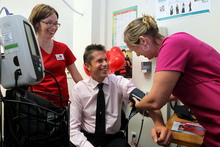
Compared with a 2002 Auckland study, average pressure had increased in most age/sex categories. Photo / Duncan Brown
EXPAND
Compared with a 2002 Auckland study, average pressure had increased in most age/sex categories. Photo / Duncan Brown
The average blood pressure of New Zealanders in middle life appears to have increased, an "alarming" finding that could contribute to a predicted rise in the heart attack death rate after a 40-year-long reduction.
Hypertension - abnormally high blood pressure - increases the risk of stroke, heart failure and heart-artery disease. It can also eventually damage the kidneys and eyes. High blood pressure can be caused by obesity, high intake of salt or alcohol, and lack of physical activity.
.......
In 2008/9 Mew Zealand adults ate 9g a day, unchanged from a decade earlier and well above the recommended maximum intake of 5.8g.
Under pressure
31 per cent of adults have abnormally high blood pressure
15 per cent report taking drugs to reduce blood pressure
35-54 year-old NZ Europeans and others - average blood pressure up since 2002
35-74 year-old Maori - average blood pressure up since 2002
Source: Otago University and 2008/9 Adult Nutrition Survey
http://www.nzherald.co.nz/lifestyle/news/article.cfm?c_id=6&objectid=10877548
_____________________________
Gary:
Elevated calcium = arteriosclerosis
Rising blood pressures is a concern.  However; medicating the problem and excessively restricting salt is not the solution and may actually cause a further reduction in health due to the many subtle side effects of medications.  Low salt may lead to confusion, fatigue, water retention and even osteoporosis.

Yes, there is far too much refined salt in the modern diet and this must be reduced.  The best way to reduce this is to avoid processed foods and fast foods as much as possible and replace these with good home cooking.

Replace refined salt with pink Himalayan salt

Compare the label of ingredients of pink salt with the list of elements on the hair tissue chart to the upper right and you will see a remarkable similarity:  They are almost the same!  Remarkable!  The salt of the Primordial Ocean (Himalayan) is very close to the mienral salts found in a healthy human cell - more or less.  I have discovered that pink salt appears to "normalise" blood pressure when used to replace refined salt.

Arteriosclerosis may be the most important driver of increasing blood pressure

This is the process of our gradually turning to stone: starting with the deposition of calcium in the arterial walls.  As the arteries calcify, they become increasingly inflexible, raising both systolic and diastolic blood pressures.

Have a look at the hair analysis chart above and you will note elevated calcium levels.  Low calcium, relative to magnesium is the pattern we look for that is indicative of the process of arteriosclerosis.  This pattern is present in about 80% of all hair tissue mineral analyses that I do, including children (early starters in the development of cardiovascular disease).

Incidentally, high calcium relative to potassium is the pattern that indicates a tendency for extreme fatigue and even depression.

Simply put: The problem of high blood pressure boils down to these:

  • Too much refined salt that has replaced the pink salt that has been used for thousands of years.
  • Too much calcium in the diet.
  • Not enough magnesium, other trace nutrients and nutritional cofactors.
Of course there are several other factors not to be ignored, such as being overweight, stress, smoking and lack of exercise; but the ones above are almost completely ignored.  Silly, really, because they do improve health!

More reading:


The advice in these articles is given freely without promise or obligation. Its all about giving you and your family the tools and information to take control of your health and fitness.

Wednesday, January 18, 2012

About salt replacement during marathon training


Gary sweating like crazy while cycling around
Upolo, Samoa
Hi Gary
Sorry for the late reply - i actually had replied to your email about potential Adrenal Fatigue (I'm training for the gold coast marathon, and it's summer time in Qld, i had been suffering from dehydration) ....

I had a good read of your website like you suggested. Some great info. One thing that really stood out was the Pink Salt. 

All i can say is, WOW - what a difference. 

That 1st week using it, was my biggest volume week in many months. 
And the next week, This week, looks set to be a bigger volume week again - Should easily hit 7hrs. (It's now Sunday - last day of week, and 6hrs 20min done for the week, 2hrs done Saturday and will knock out 1hr today for weekly total of 7hrs 20min) And this week had a massive Heat Wave from Sun - Wed. 

No issue with dehydration at all. Loving it. 


The Hair analysis is a great idea - esp when things are not going according to plan. I have a few clients like that. (alcohol normally.....)  


I still cannot get over how well the Pink Salt has effected me - It makes perfect sense too. 
You're a life saver
Regards
_______________________________________________

Gary:
Thanks for the feedback - always appreciated.

One thing this email highlights is the solutions to many health and training issues are often ridiculously simple and often very obvious.  In this case the leading cause of this runner's dehydration and exhaustion was lack of salt.  Runners need heaps of salt and one of the worst things they can do is follow a low salt dietary regime.  But not just any salt.

Avoid refined salt which has only NaCl plus a little iodine in it.  Go for the salt that civilisations were built upon the trade of - pink salt which contains at least 80 different minerals, including NaCl.

Public health sound bytes such as "cut the salt" are not always right.  In fact this health byte has got it terribly wrong and have done so for the last 20 years and caused so many health problems such as chronic fatigue, confusion, blood pressure problems, osteoporosis, thyroid and adrenal disorders and heart disease.  The new health byte should be:

"Cut the refined salt - Increase the pink salt!"

To date, I have seen no health problems with consuming pink Himalyan salt daily at the base rate of about one rounded teaspoon per day - more if you are doing heavy exercise and sweating a lot.  All I have seen is health benefits including better sporting performance.


_______________________________________
About this website
The advice in these articles is given freely without promise or obligation.  Its all about giving you and your family the tools and information to take control of your health and fitness.

Monday, August 01, 2011

Low Salt Diet Found to Increase Mortality

by Jeffrey Dach MD

The Low Salt Diet Revisited

A recent study on the effect of a low salt diet made headlines, finding that a low salt diet increases mortality for patients with congestive heart failure.(1-6)  The study concluded there was not enough evidence to advise a low-salt diet for the rest of us.  They doubted a low salt diet would benefit the population.(6)  In this article we will re-examine the low salt diet, clear away the confusion, and make recommendations about salt intake, hypertension, and health.  

http://jeffreydach.com/2011/07/22/low-salt-diet-found-to-increase-mortality-by-jeffrey-dach-md.aspx
__________________________
Gary:
Thanks you Dr Dach for such a comprehensive review of the evidence and for backing up what I have been saying for several years now - salt is good for you! (So long as it is the right kind).

I have more than quadrupled my intake of salt over recent years, after a decade or two of trying to restrict intake. This increase has been principally through the use of Himalayan Sea Salt which most closely replicates the mineral makeup found in the healthy human being.  Despite this big increase in salt intake my blood pressure is a healthy 100/70 and I feel great.

Here is what I have written most recently on the subject of water consumption and salt.

And here about low salt diets.

And about reversing cardiovascular disease.

Please help get the word out by passing this article onto others, thanks.

_______________________________________
About this website
The advice in these articles is given freely without promise or obligation.  Its all about giving you and your family the tools and information to take control of your health and fitness.  Please give me your support by subscribing to my free email updates. Please shop at my Online Store. Please encourage your family and friends to do the same. While we may not always be able to compete with the big operators on price, we aim to more than compensate through personal service!

Your email address:

Powered by FeedBlitz
Do you have a question?  Email Gary: gary@myotec.co.nz. Include any relevant background information to your question.  Please be patient and be aware that I may not be able to answer every inquiry in detail, depending on workloads (My paying clients take precedence!). I will either reply by email or, most likely, by way of an article (Personal identifying details will be removed before publication).