"How much sugar wud switch your body from running on body fat to runnning on sugar. for example would a single barley suger during a marathon switch ones body to suger as fuel???? the reason that I asked is because I was given a barley sugar just before the 20km hill I was going fine until then just over that hill I crashed and burned, the barley sugar was great to suck going up the hill but was it my undoing??"
- Anon
_______________________________
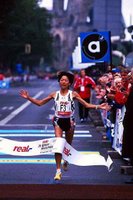
World class runners go at a pace so fast that it is
next toimpossible to take in carbohydrates and
only a few cups of water, so they train for this.
Dear Anon,
Sorry, Mate; but you can't blame the barley sugar for the crash and burn act. It was probably the 8 week build-up to the marathon that was your undoing.
Your inquiry raises a few interesting points that I will try to cover:
- Do at least 12 weeks training before a marathon, preferably the best part of a year. Each week, at least one run should be long and slow and completed without sustenance other than water. Follow the guidelines in the "Training for a Marathon" e-pub. Have a diet that is low in refined carbohydrates (whole grains and unprocessed carbos are essential). It will take at least 12 weeks of this kind of training to adapt; and you will notice with delight that you can go longer and faster during these long runs without getting irresistible carbo-cravings.
- Doing what is recommended in (1) will help your body conserve its internal carbohydrate stores during a race like a marathon, enabling you to run longer and faster before hitting the wall. While there is no "switch" between fat and carbohydrate metabolism (Useage is in terms of ratio, rather than just one or the other), there does come a critical point in body carbohydrate store depletion where the body and brain appear to do a sudden drop in performance - the wall. this can feel a bit like throwing a switch.
- When you are running really hard, it is almost impossible to take in anything other than the smallest quanity carbohydrate without suffering disabling stomach upsets. This is why the training as outlined above (1) is so important. The only other way to avoid hitting the wall is to run much slower and to eat and drink as you go. But, the more you take in, the slower you must go and that means a long time out on the road, which can be just as hard as trying to go fast.
- Trying to eat and drink, including sucking a barley sugar, when going at anything other than a slow pace also causes interference with breathing and running rhythm. This can force the runner ever so slightly into oxygen debt. This hastens the hitting the wall.
So Anon, when you felt yourself seizing up, the best thing you could have done was to slow right down and take on a dozen or so barley sugars, wait for the sugar to infuse the body and hope. However; with the lack of training, other metabolic problems compound the seizing up, such as the nervous system itself running out of gas (the muscles go into a kind of rigor mortis).
With regards to the barley sugars, there is an additional issue:
If you are breathing heavily, jostling and being distracted there is a serious risk of inhaling the barley sugar and chocking to death. This is why responsible coaches ban chewing gum and sweets during training and competition. Barley sugars are fine if only walking slowly; but not if the pace is brisk and definitely not if running. The better choice is a sugary drink and soft caramel bars.
However, Anon, if you start training now (you are allowed 10 days rest) you will find that everything is so much less complicated when you run your next marathon.


