Gary's new website

Showing posts with label injuries. Show all posts

Tuesday, May 22, 2012

A fresh warning about the dangers of cortisone injections

I continue to receive inquiries from people who have had cortisone injections to treat injuries to joints, tendons and ligaments, or have recommended that they undergo such treatment. This type of treatment remains disturbingly common and the consequences can be catastrophic.

Photo: Example of chemical excision by cortisone injection causing permanent damage to the ankle joint (note the large indentation where the lateral ligaments of the ankle once were). Only one injection is required to cripple the recipient.

Cortisone is a form of chemical excision. It kills living cells, dissolving living tissue, killing off everything it has contact with. While the relief from pain may be immediate and lasting, the adverse consequences may not appear for weeks or months or even years later. The consequences may be the catastrophic snapping of a tendon or muscle, loss of protective ligaments or the loss of protective cushioning tissue, such as that found in the heel pad. While many people get away without apparent long term consequences, I can tell you that many people definitely are not so fortunate.

Why is it that cortisone continues to be used to widely and for so many different musculoskeletal problems?

  • It is cheap, quick and easy and can be done in any medical consulting room
  • Relief from pain is instant and it tends to lastJust 1-4 injections seem to do the job which is usually much better and quicker than one would get than other therapies like physio
  • If there are any catastrophic consequences, the association with the cortisone injections may never be known and the injecting Dr will never be any the wiser
When a Dr tells you the "risk is 1/1000" bear in mind that this estimation may be based on worthless stats that do not take account the dozens and dozens of unreported adverse side effects that run parallel to each reported case!

If you have an injury that fails to respond to rest and/or medical treatment, or are bothered by chronic pain and treatment with cortisone has been recommended, you are welcome to write to me and I will do my best to assist with helping you with deciding on what is the best course of action to take.

Friday, November 09, 2007

Tibial compartment syndrome in running sports

Tibial compartment syndrome condition was first recognised in relatively unfit army conscripts who were made to do forced marches wearing heavy boots and carrying heavy loads. It is now seen principally in athletes who have a tendency to pack on the muscle.

This elite athlete has been able to manage his calf pain without surgery or drugs by following the guidelines outlined here

If the lower leg muscles swell, usually from excessive training too early on in the build up they may become compressed. This is because of the unusual anatomy of the lower leg with the big calf muscles, nerves and blood vessels partially wedged between the tibia and fibula bones and the exposed muscle of the shin and calf encased in a strong fibrous sheath. If the muscle grows too quickly or swells from over use, there may be insufficient room to expand. The result is a kind of tourniquet effect.

The pressure inside the muscles steadily increases as exercise progresses and the muscles swell and the blood flow within the muscles eventually becomes insufficient to maintain metabolism and to flush out metabolic wastes, causing ischaemia which feels like a burning cramp in the affected area. This causes progressive tightening, swelling and cramping of the lower leg muscles as the exercise session progresses. A viscious cycle takes hold. Rest may give only temporary relief, even after several days of rest. The pain may be intense and disabling. The affected areas may feel hard and painful to press with the fingers. This condition is easily mistaken for cramp or a calf strain.

Tibial compartment compression may occur in the highly muscular person who uses an excessively "toey" running style, or who does a lot of hill climbing or sprint work that encourages excessive muscle hypertrophy. A high intensity sport like field hockey that involves an enormous amount of sprinting off the mark, sudden stopping and changing direction over an extended time may produce tibial compartment syndrome.

Compartment syndrome is a potentially serious condition because, if the blood flow through the muscles
does not resume within a short period of time, the affected muscles and nerves can die. If you do suffer intense cramping pain of the lower leg during exercise and, if there is no relief within minutes of ceasing activity, consult an emergency doctor immediately and do not tolerate any waiting about - treat it as an emergency until there is medical evidence to the contrary.

Prevention is always best

Make all of your training slightly incremental over several months and include speed work at least once a week so that your muscles can gradually adapt, rather than being slammed by the unexpected.

If you are going into a new phase, such as hill work, make the transition over a week or two, rather than in just a single session or two.

Schedule recovery days and weeks in your training schedule rahter than train intensely every day.

Take a few extra days off if you have excessively sore muscles following a work out.

Be diligent with ensuring a nutrient rich diet, including a rich intake of magnesium. It is advisable to take up to 800mg of supplementary magnesium per day for up to three months and then continue with half that amount indefinitely.

Ensure that you have strong and flexible hips and a strong low back so that the hips and upper legs are used as your prime running muscles - if they are weak and tight, you will be forced to make excessive use of your lower leg muscles when running.

Even if your feet are perfect, do exercises for preventing pronating feet. While your feet may look perfect, this may not be the case 10-15km into a run as fatigue sets in.

Get a regular deep tissue massage of the calf muscles to keep them and the sheaths that encase them soft and pliable. If you are in Wellington I can do this for you.

If your calf muscles begin to seize up during intense exercise:

Stop running or whatever it is you are doing.

Lie down and raise your legs just a little with something comfortable such as a soft kit bag - not too high and do not compress the back of the knees

Have somebody gently massage the lower legs for several minutes, pushing the blood towards the heart.

Drink if dehydrated.

Have in your kit bag some Cramp Buster capsules. These contain a mix of magnesium and potassium. Break two capsules open, dissolve in water and drink the lot. This may help relieve the spasm. Take plenty of vitamin C to help offset the free radical damage over the next few days.

Consult a doctor immediately if significant relief does not happen within about 15-20 minutes.

Continue to have regular leg massages.

Gradually resume running using the walk-run strategy and stay close to home.

Wednesday, May 17, 2006

Pouring cold water on ice therapy for sprains, strains and bruises

You are probably wasting your time applying ice to that sprained ankle or inflamed tendon and possibly even doing it some extra damage.

Before I explain myself, a little history about ice therapy in NZ:

Back in the late '70's in my role as the ACC's National Coordinator of Sport and Recreation Safety, I attended a combined physiotherapy and sports medicine conference in Dunedin. The All Black's team physiotherapist, Peter Stokes, presented a paper on the the use of Ice, Compression and Elevation (ICE) for the first aid treatment of soft tissue injuries. I subsequently devised a public education campaign directed at sports coaches and sports people and this was delivered principally via the NZ Federation of Sports Medicine which had active branches throughout the country at the time. Back in those days, the treatment of choice was heat rub, massage and running the injury out. Much emphasis in the campaign was therefore placed on getting rid of these harmful practices. It was natural, therefore, to emphasise the "I" in the ICE. As we all know what to do nowadays, I am proud to claim this campaign was obviously a huge success.
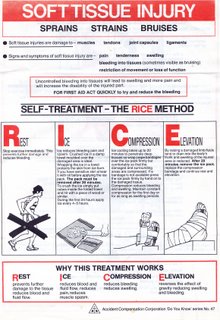
The brochure to the right is the front page of the original that I put together. Incidentally, the illustrations were done by nationally ranked middle distance runner, Alastair Leslie, who I was assisting with coaching at the time.

But does it work? The rest does (the elevation and the compression); but probably not the ice.
  • Rest - for about 36 hours ensures time to properly seal small blood vessels that have been disrupted.
  • Compression - for about the same time prevents fluid, including blood from engorging the damaged tissue and joint spaces while the clotting process seals off the damaged blood vessels.
  • Elevation - several centimeters higher than the heart will stop blood flow into the damaged area (The most effective way to stop a cut finger bleeding is to compress the cut and hold it above the head - try it next time).
Ice might reduce blood flow a little by causing a constriction of the blood vessels. But, cool the area too long and the opposite happens. Sure, cooling the area might marginally reduce the pain; but who cares! Acute pain has a purpose. Incidentally, compression is another means of dulling the pain. Ice applied to an area risks causing ice burns. I have seen many cases of ice burn and the damage can be serious in some cases. Some people have very sensitive tissue and are best advised to avoid ice therapy altogether. The consequence of excessive cold is SWELLING - the very thing the ice was applied to prevent! Pouring cold water on the injured part might seem safer; but the problem is the more important compression and elevation are probably not happening while this is being done and the injured body part will probably be well below the heart. Not good if the intention is to halt bleeding.
However; an ice pack consisting of crushed ice, or a packet of frozen vegetables wrapped in a damp towel, can make an effective pad for compressing a badly bruised or torn body part.
Never apply frozen things directly to skin, which is why we say that it must be wrapped in a damp towel. Remove the ice after about 5 minutes and continue the compression with a soft pad only that is held in place by firm, but not painful pressure by the wide pad of the hand and/or an elastic bandage that extends well above and below the injury site. Any bandages should not be so tight as to cut off circulation to a limb.
If, for example, you sprain an ankle; this is my recommended course of action:
  • Stop and lie down - choosing the first available warm, dry place. You must keep warm
  • Raise the ankle above body level asap
  • Hold that position for up to 15 minutes (You need to give the damaged blood vessels time to seal with a blood clot before putting the leg down and moving about)
  • If a compression bandage is available, apply this while the leg is elevated and use enough banadage to cover the whole foor to the toes and all of the bottom half of the lower leg
  • After about 15-20 minutes, you can make the move to a more permanent place to continue the rest, compression and elevation for a few more hours.
  • After about 36 hours and so long as nothing is broken, it is recommended that you start weight bearing and moving about, doing your absolute best to walk with the foot straight and without a limp.
  • Continue the elevation and compression between exercise for as long as swelling is evident.
  • If there has not been a significant improvement in pain and mobility within about 48 hours, you should think about getting on down to the emergency department or seeing your doctor, just in case you have broken a bone or popped a tendon.
  • From about 72 hours, all going to plan, you can carefully and gradually resume normal activities.
Notes:
  1. If you feel a tearing or giving way sensation at the moment of injury or hear a popping or snapping sound, you may have ruptured an important structure that requires early treatment. This kind of injury can sometimes be deceptively painless at first. See your doctor asap and report what you felt or heard.
  2. Even if you think you might have done a serious injury, don't rush off to the emergency clinic. Stabilise the injury first by an hour or so of compression and elevation. Rushing around and then waiting for hours at the emergency clinic, to only be seen by a junior doctor, may be the worst thing you can do, possibly setting your recovery back by days, if not weeks. Ring the department and find out what is the best time to come in. You might even be better off booking in to see a General Practitioner with postgraduate training in sports medicine in a day or so.
  3. If it is an accident, then there is no excuse for getting medical help in countries like New Zealand, since most of the medical costs are covered by ACC or a similar agency.