Gary's new website

Showing posts with label deep vein thrombosis. Show all posts

Monday, January 26, 2015

My ankle fracture-dislocation two weeks on: Healing, detoxification, fatigue, dangerous drugs interactions and circulation issues

Two weeks have passed since I tried to rip my foot off and, for the first time at ten days, I have been able to inspect the surgeon's handy work.  Please read my earlier article here:

Things have actually gone very well, although there have been a few issues, such as a very unpleasant and rather frightening drugs interaction, which I will discuss later.

This article covers what I have been doing post-surgery to facilitate a quick and uncomplicated recovery, including pain management.  First of all, let's take a look at what can be seen at 10 days post-injury when the plaster has been removed so that the stitches can be taken out and another cast is fitted for a further four weeks:


Some swelling as to be expected; but minimal signs of bleeding which confirms that my immediate first aid measures worked.  Refer to my earlier article here.
Bleeding into tissue, dead cells and swelling all compromise healing, so the less - the better for there to be a quick and uncomplicated recovery.


Excellent wound healing.  No excess inflammation at all.  I have been taking special supplements to help regulate inflammation and to help the body dissolve and excrete dead tissue and blood clots.  These need to be removed before healing can happen in earnest.

Dead blood in the foot and some discoloration from the surgical disinfectant;
but not too much detritus to worry about.

I've seen worse looking ankle sprains, so I'm delighted with how things are looking.
Not pretty; but I am delighted that there is some promising movement in the joints: A little plantar flexion, dorsiflexion, pronation and supination.  I'm off to a good start!  Enough of that - its back into plaster for that leg.

Managing Post-surgical pain and swelling 

When joints, bones and soft tissue are violently disrupted, such as happened to my left foot, blood vessels are ruptured (thankfully only capillaries, low pressure veins and not high pressure arteries).  If this is not bad enough the trauma is compounded by the hours of surgery to realign the broken bones and displaced joints.  This involves quite a lot of hacking, wrenching and screwing which is all additional trauma.  

Blood continues to be pumped to the foot (thankfully!); however, the blood flow back to the heart is compromised due to the damage to the peripheral veins and capillaries.  Similar damage has been done to the tiny lymphatic drainage vessels and this will be seen as swelling of the foot.  Being immobilised in a cast makes the circulation problem worse because the muscle pump effect of muscular contraction and relaxation is no longer available to pump blood and lymph fluid back to the heart. The consequence is the foot will go purple and blow up like a balloon if it is not constantly elevated.  

Constant fatigue, swelling and throbbing of the foot have been the main problems I have been having to deal with and I have found it most unpleasant and requires constant lying down, now causing an unpleasant rash on my lower back.

If you visualise the extent of the damage done to the bone and soft tissues around the narrow collar of my ankle, you'll appreciate just how badly the circulation through my foot has been compromised.  How much?  10%?  20%?  I have no idea other than to say that it feels like a whole lot!

This means regrowing a whole lot of tiny blood vessels.  I am helping this along by taking a mix of supplements that enhance circulation, support tissue healing, break down dead tissue, including fibrin and support liver and kidney with handling the toxic load.

Example of almost instant unpleasant swelling and stagnation of blood flow if the leg is not elevated
Leg elevated: dark, deoxygenated venous blood drains out of the leg quite quickly and the feeling of pressure is relieved.
Note the very healthy tomato plants in the background.  I am very proud of them (I have very little to occupy my mind right now!)

Pain Management

I have been reluctant to take much in the way of pain medication.  This is because I need some pain feedback to tell me when to change position and when to raise my leg.  Pain is your friend unless it becomes so intense as to cause suffering and debilitation.

The two pain medications that I have been taking is Tramadol and paracetamol.  Initially this was at the minimal rate of just one of each in the morning and the same again at bedtime.  By Day Ten I had reduced this to one of each at bedtime only.  

The problem with these drugs is they are tough on the liver and kidneys and I need these organs to be working at 100% to clear the dead tissue from my body without compromise.  Paracetamol has a number of serious complications, including asthma, skin reactions and liver failure.  Tramadol is a narcotic-like drug and can be highly addictive.  It is also toxic to the liver and kidneys.  So, while I have been taking some up till now, it is very little only as much as is needed to make life bearable.  As of today, I do not think I will need any more drugs from now on for pain management or sleep.

I have also been soaking in a large, hot bath with a handful or two of Epsom Salts in the water to help relax the muscles.  The bath brings about profuse sweating like in a sauna.  Sweating is an effective way of ridding the body of metabolic toxins, while bypassing the liver and kidney.  Its easy to prop the cast on the side of the tub and getting out is a good workout for the upper body.

The most effective pain management is elevation which I am having to maintain constantly for now.

This has worked quite well and I am noticing improvements each day, although the warm nights have made sleeping comfortable almost impossible with a heavy, sweaty cast on my leg.  In fact, I have been so restless at night it has been almost to the point of despair.  Last night I seriously thought of cutting the cast off.  I so want to move my ankle.  But that will have to wait another four weeks.  I am so over it!

A potentially dangerous incident of drug interaction

Two nights ago my partner, Alofa, arrived home later than usual from doing the weekly groceries.  She had purchased half a dozen craft beer and handed me a bottle which I enjoyed very much.  About an hour later I went to bed, thinking nothing of as I swallowed a Tramadol capsule.  About half an hour all hell broke loose:  I began to twitch and fidget uncontrollably, scratching my scalp face and body.  My body was burning hot and I was becoming almost uncontrollably anxious.  My pulse was raised about 20 beats above rest.  I figured I was having a reaction to the combination of Tramadol and alcohol, although both were small amounts.  I hopped to my office where I hooked up my blood pressure, pulse and temperature equipment and waited.  Squirming and scratching.  It did occur to me that I would have to get the ambulance if things got any worse!  However, my vital signs were okay, so I resolved to wait it out.

By about 1.30pm I was beginning to settle and was able to return to bed shortly after for the reminder of what was a less than pleasant night.

Although I was aware of the danger of mixing narcotics with alcohol, including convulsions and death, I got well and truly caught out.  Brain fade.  The lessons I have taken from this distressing brush with drugs interactions is to be extremely vigilant by keeping the brain in gear at all times and that it is best not to take any drugs, or the least possible.  Its just far too easy to make a mistake.  In my case, I am so thankful that I took only one Tramadol and not 2, 3 or 4!  

Post-injury fatigue

Two weeks have passed and all I still feel like doing is lying back, dozing off and sleeping.  This is because I need to.  There has been a huge amount of damage to my leg - twice, if you think of it - once from the accident itself and then a second insult from what added up to almost half a day of surgery.  Over the ensuing days and weeks, toxins are flooding into the circulation where the liver then works like a huge filter to pull them out, neutralise their toxicity and then excrete the end products through the kidneys and the bile.  The initial toxic load is from a mix of medications and the contents of cells that were destroyed during the accident and surgery or shortly thereafter.

Clotted blood that fills the injury site must be dissolved and removed from the injury site for healing to happen.  Tissue that survived the initial insults of injury and surgery may be stressed and die from the combination of being surrounded by toxic dead cells and their contents, smothered by congealed blood and poor oxygenation due to blood vessel damage.  Much of this secondary damage can be avoided by flooding the body with a mix of powerful anti-oxidants and ensuring that there is minimal pooling of blood and swelling.  I have had these measures in place from the very beginning and they are working well, by the way.

The end result of this toxic overload is fatigue, fatigue, fatigue - and bad breath!  I feel similar to a person who has hepatitis, Tapanui Flu, glandular fever or post-viral fatigue syndrome.  The management of these is to focus on supporting enhancing liver function with a mix of various herbs and supplements such as milk thistle, lipoic acid, a multi mineral salt and even good old vitamin C!  Sweating daily and drinking plenty of fluid are also most beneficial.

Most important is my body is telling me to rest.  I am tired and for good reasons that are not to be ignored or circumvented.  Sure, I would like to get exercising and back to work today but I would be foolish to do so.  My body needs rest for the time-being and that is what I am doing.  Exercise and working are tiring and keeping the leg elevated all the time is impossible, so healing and recovery will be compromised and may delay a full return to work and sport.

I know I have a tough job ahead of me to regain full function of my left foot.  I agree with the surgeon that arthritis is a high possibility, given the extent of the damage.  I do want to resume my quest to win the world mountain bike champs in 2016 and I do want to go for some age group running events later.  For this to happen, patient rehabilitation is the name of the game.  Patience is the key!

My next article will deal with resuming exercise gradually and safely while still hobbled in plaster.  I am just about ready to go.

More related articles:


About this website 
The advice in these articles is given freely without promise or obligation. Its all about giving you and your family the tools and information to take control of your health and fitness.
Candida and Fungal Infections? Gary Moller recommends you explore this programme: Click Here!

Friday, December 19, 2014

Does compression clothing really work? (updated)

Compression Calf Sleeve by McDavid

"What is your view on compression clothing (ie- skins), is there any scientific proof that they actually improve recovery and performance or is it just a great way to get people to spend waaaaay too much money on a pair of tights??"
______________________________________
Gary:
Unfortunately, it is the case with many good ideas, that the commercial imperative to make more and more profits, while things are "hot", ends up taking precedence over everything else, including actual proven benefits and even common-sense.  I think this is the case with compression clothing - a good idea that has some limited benefits and applications, which has been promoted way beyond any real benefits.

The limitations of compression clothing 

When a muscle relaxes, it engorges with oxygen and nutrient-rich arterial blood which  nourishes the muscles.  When the muscle contracts, the now deoxygenated blood is forced via the veins back towards the heart.

Compression Pant by McDavidAt rest, all blood flow is driven by contractions of the heart.  As the muscles begin to contract, their action takes on more and more of the job of pumping blood back to the heart.  When exercising at maximum aerobic capacity, as much as half of all your circulation through the exercising muscles is being driven by the muscle pump effect.  When there is perfect balance between the heart and the muscles, this is when the athlete is in the "zone".

If a person is suffering from adrenal exhaustion (About 80% of the general population have a degree of adrenal fatigue), then one of the unwanted symptoms is pooling of blood in the limbs due to blood vessel flaccidity. This appears as distended veins in the feet, calves, hands and arms when standing still, as well as sometimes feeling light-headed when standing up and even suffering heart palpitations.  Varicose veins may be the consequence of excessive ongoing pooling.

It is possible that a person with flaccid blood vessels may experience some benefits from wearing compression clothing because the compression clothing may counter the tendency of the blood vessels to distend.  This clothing may be beneficial for an exhausted athlete during long haul travel, reducing the risk of deep vein thrombosis.  I recommend compression clothing, if a person has varicose veins.

Compression stockings may give temporary relief to conditions like shin splints by dampening the shock wave of foot impact as it travels up the leg.

However; compression clothing may be seen as being a short term measure for conditions like these by treating the symptoms and not the causes (Adrenal Fatigue, nutrient deficiencies, over-training, faulty biomechanics and so on).

If a healthy athlete with toned blood vessels was to wear compression clothing would there be a performance benefit during exercise?  

I think not and there may even be a negative effect.  This is because the veins and muscles of the exercising person must be allowed to quickly and effortlessly fill with blood while momentarily relaxed, so the blood can then be expelled towards the heart during the next muscle contraction.  If there is even slight external pressure, such as from compression tights, then the volume of blood within the muscle body and veins may be less than if there was no external compression at all.  This may cause an overall reduction of blood flow and the heart may have to work harder to force blood into the muscles.

Let's think about this in Darwinian terms:  If tight skin conferred a survival benefit, such as more speed and endurance to catch prey or escape predation, then that creature would thrive.  Can you think of any animals with tight skin?  I can't.  It would appear the case is the opposite.  Skin that does not compress allows free movement of limbs and unimpeded circulation.

While there may appear to be a majority of research in favour of compression tights  this does not necessarily mean all that much because of the widespread practice of what's called "cherry-picking", which is the widespread practice of discarding research that does not support one's position while selecting those that are positive. Another dodgy practice is to simply over-interpreting the findings and extending the claims of benefit beyond the small group of subjects that might have received some benefit in the study.

Such is the pervasive influence of commercial funding of academia nowadays that we must be sceptical of what comes out as research; especially of research that appears to go against common-sense.  At least 70% of all scientific research never sees the light of day.  It is referred to as "filing cabinet studies".  Of the 30% that gets published, less than 10% gets into mainstream media, including sporting and fitness publications and websites - and these are the best of the few studies that are mostly favourable, given that sponsors of the research may be, or have links with, the makers of products and services that will benefit from favourable research findings.   Research beneficiaries may be heavy advertisers with sporting publications and sporting events, including making direct payments to athletes and prime influencers.  Directly and indirectly, commercial interests an unpleasant influence on editorial decisions about content.

The moment there is the exchange of money or goods, there is a conflict of interest and the loss of credibility of any claimed benefits by the recipients.

I have learned the hard way that, articles containing advice that conflicts with the products of advertisers will usually be rejected.  For example, advice to drink tap water during training in preference to sugary and acidic sports drinks, does not sit comfortably within a sports magazine that has full page advertising for a sports drink. It is even worse if I was to suggest how to make your own electrolyte drink for just a few cents.  Nor is it advisable to recommend that children run about the fields barefoot when the main advertiser is the magasine is a sports shoe company.  When was the last time you read an article in a sports magasine about the harm to health, including teeth and gums, caused by energy drinks?  There are lots of articles about the performance benefits.

In conclusion about compression clothing:  

If it is a cold day, wear warm tights or trousers.  If you are doing a long haul flight, or road trip,  then compression tights might reduce risk of blood clots.  If you have varicose veins that hurt or swell excessively during exercise - yes - experiment with compression clothing.

If you appear to have flaccid veins and suffer from lightheadedness, you would be wise to invest some of your your money on an adrenal fatigue recovery programme, while undertaking a review of your exercise, nutrition and lifestyle practices.

As consumers we must be forever on our guard, lest we be suckered into parting with our precious money for things we don't really need.

If your spending choices are driven by fashion - go for it!


_______________________________________
About this website
The advice in these articles is given freely without promise or obligation.  Its all about giving you and your family the tools and information to take control of your health and fitness.  Please give me your support by subscribing to my free email updates. Please shop at my Online Store. Please encourage your family and friends to do the same. While we may not always be able to compete with the big operators on price, we aim to more than compensate through personal service!

Your email address:

Powered by FeedBlitz
Do you have a question?  Email Gary: gary@myotec.co.nz. Include any relevant background information to your question.  Please be patient and be aware that I may not be able to answer every inquiry in detail, depending on workloads (My paying clients take precedence!). I will either reply by email or, most likely, by way of an article (Personal identifying details will be removed before publication).

Wednesday, March 05, 2014

How to prevent deep vein thrombosis (DVT) in athletes and traveling sports teams (updated 5/3/2014)

Introduction
Deep vein thrombosis (DVT, phlebitis) among apparently healthy men and women is disturbingly common.  I will see as many as two cases per month.

Example:
Former national class runner, now in early 60's, developed a calf strain after a short run.  This coincided with a journey by car to Auckland and back to Wellington.

He had booked in with me for some deep tissue massage of the injured calf.

He struggled into the office and had a pale complexion and a hint of purple on the lips.  Since there was no history of an actual injury to the ankle I concentrated on assessing his pulses, blood pressure and circulation.  On the basis of what I found, I referred him immediately to his doctor who immediately referred him to the hospital where it was confirmed he was suffering from blood clots in his leg.

To have massaged the leg, anything other than gently, may have dislodged a clot, which may have then found its way into the lungs - not good!

Cases encountered over just one Christmas period: 
Four males training as endurance athletes (running and cycling). They had come to see me for help with calf pain. Two required hospital specialist treatment. One developed a blood clot on his lung. A fourth person was sent off to his doctor with a suspected silent heart attack. 

Massage Therapists - take note!
If a person, including an athlete comes to you for a massage of a sore calf muscle, consider the possibility that the pain is due to a deep vein thrombosis. You may be the first health professional that a person with DVT related pain seeks out for relief. Be vigilant! Massaging a limb with a silent DVT may prove fatal. Be aware of the signs and symptoms and do not hesitate to get medical help if a DVT is even remotely suspected.

Few people realise that athletes and very active people are among the most at-risk of developing a blood clot

But why did I encounter so many cases around Christmas? Well: Its easy to see why - Over-training, exhaustion, the excess stress of last minute work pressures, standing about at end of year corporate functions, drinking alcohol and eating too much fatty finger food; and then there is the Xmas shopping, kids not at school and then to top it all off - the relations arrive!

How to prevent deep vein thrombosis in athletes and traveling sports teams


Did you know that the circulation through the lower legs is reduced by as much as 50% when standing and 70% when sitting? 

This has serious implications for the traveler. Blood which has already given up much of its oxygen and is burdened with metabolic wastes is now pooling in the legs. When blood stagnates like this it steadily loses its freshness. This is not good for your health and general well-being.

An athlete preparing to produce a world-class performance needs healthy red blood cells for peak oxygen transport and it may take up to three weeks to fully replace any damaged ones.  If such damage has been done to blood cells then this is a good explanation why many athlete are feeling "flat" for a few weeks after long haul travel and seldom produce personal bests in competition.

New Zealand athletes may be at greatest risk of under-performance and harm from DVT because we have to travel further than any other sporting nation for international competition.

Are athletes at greater risk?


  • Three Olympic athletes from the British team were treated for DVT in Australia 2000.
  • It has been claimed that people who are athletic account for ten times more victims than any other risk factor.
  • "About 85% of air travel thrombosis victims are athletic, usually endurance-type athletes like marathoners. People with slower resting blood flow are at greater risk of stasis, stagnant blood subject to clotting. Also, they are more likely to have bruises and sore muscles that can trigger clotting. No other risk factor comes close to this. Age over 60 is supposed to be a risk factor, but these victims are younger, 82% of them under 60". (http://www.airhealth.org/athletes.html).

Possible explanations are:

  • Athletic people with a lower resting pulse could be at greater risk of stasis, stagnant blood subject to clotting.  The lower the pulse, the higher the possibility of blood stagnating in the legs.
  • Some athletes cheat with "blood doping", using a hormone called EPO, to increase their red blood cell volume.  This thicker, stickier blood is very prone to clotting (Blood clots in race horses was once a common cause of death - excessive use of EPO).
  • Athletes may have better-developed superficial veins carrying more blood, reducing the flow in deep veins while at rest.
  • Athletic people may be more likely to have bruises or sore muscles which could trigger clotting. Recent injury, even a bruise, is a well-established risk factor.
  • Adrenal fatigue is rampant in athletes.  Adrenal fatigue causes low blood pressure, an excessively low pulse and consequent pooling of blood in the legs.
  • Adrenal stress also increases blood clotting rate and is associated with poor venous tone, causing pooling in the legs.

What is deep vein thrombosis?


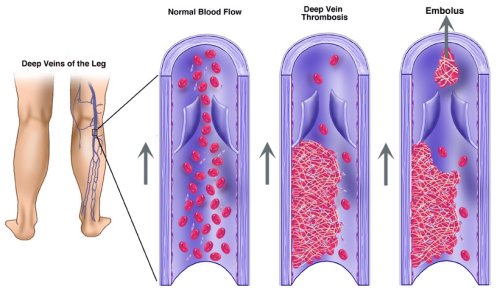
Much has been said and written recently about the dangers of economy class syndrome, or deep vein thrombosis (DVT). DVT refers to the formation of blood clots in the large veins of the body – usually in the legs and groin and sometimes in the arms and shoulders. It is sometimes referred to as phlebitis and there can be serious complications if a blood clot were to break loose and lodge in the lungs. Up to 20% of the total population could be at increased risk of developing blood clots. It has been estimated that there could be as many as four or five DVT cases per long haul flight with up to 10% of passengers suffering symptomless DVT. While DVT has been popularly associated with the cramped conditions of economy class travel, nobody is immune.

About 85% of air travel thrombosis victims are athletic, usually endurance-type athletes
When sitting, especially with the knees crossed, or if the edge of the seat is digging into the back of the knees, the blood vessels to and from the legs may be kinked and compressed. Muscles act as accessory pumps to the heart, pumping blood back to the heart. With knees bent and without regular and steady contraction of the leg muscles, the blood flow through the legs is seriously reduced.
The same processes occur with the lymphatic circulation which refreshes the clear fluid that bathes and nourishes the body’s cells. If the lymphatic fluid is not pumped out by muscular contractions it pools in the limbs like stagnant pond water. This may show as visible swelling of the lower legs or hands. This is a very unhealthy condition for anybody - especially if you already have circulation problems.

Whether it is in a cramped aircraft cabin, motor vehicle, or an office, DVT does not discriminate

Venous blood is already low in life-giving oxygen and contains toxic waste products from cellular metabolic activity and tissue damage. This burdened blood is normally whisked back to the lungs, liver and kidneys to be re-oxygenated and cleansed - it should not be stagnating in the lower legs. If it sits about too long it will eventually go off and finally form blood clots in the leg.

Athlete or not: Nobody wants a build-up of stagnant, stale blood and fluid at any time - especially when traveling to a foreign land. Whether it is through air travel, or sitting for several hours in a car - stagnated circulation – let alone DVT – is a real threat to health and vitality. An experienced traveler will tell you that the body and brain can remain tired and sluggish for as long as 36 hours after a long journey of any kind – especially if it includes changes in time zones. The legs feel heavy, achy and swollen, reactions slow, the head may ache and breathing is laboured during exercise. Stagnant blood and lymphatic fluid that accumulated in the legs during travel is now being flushed back into the system, causing a period of general systemic toxicity.

Warning!


Deep vein thrombosis is a life-threatening condition. The following advice is for prevention - not for treatment. If a deep vein thrombosis is suspected, then the person affected must be transported immediately to a hospital or emergency clinic for assessment by a doctor - nothing less!

Signs of possible DVT (Present in less than 50% of cases, so always take care)
  • Swelling and/or discomfort in a limb, groin, shoulder or even low back
  • Cold and/or discoloured limb
  • Shortness of breath, unusual fatigue
  • Blue lips, ashen, signs of general distress
  • Racing pulse
  • Pain in the leg
  • Tenderness in the calf (this is one of the most important signs)
  • Leg tenderness
  • Swelling of the leg
  • Increased warmth of the leg
  • Redness in the leg
  • Bluish skin discoloration
  • Discomfort when the foot is pulled upward


Prevention


  • Do not sit for longer than one hour without getting up, moving about and stretching for several minutes. If in an aircraft, this means walking up and down the isle every half hour and/or doing special exercises.
  • It is often very impractical and totally unsafe to get up and walk about a plane, so do so at every opportunity.
  • If traveling by car, stop every hour for a brisk five minute walk or slow jog and don’t forget to stretch.
  • When sitting, avoid crossing the legs. If you can – keep your feet up with knees extended. Regularly flex and extend the ankles to pump the calf muscles.
  • Do not wear tight shoes or restrictive clothing, especially socks with elasticised cuffs that may cut circulation of the lower legs or feet.
  • Special compression stockings do reduce venous and lymphatic pooling in the legs and the subsequent risk of DVT. While there is no research that I am aware of to prove their worth, athletes may also benefit from wearing body-hugging athletic tights that include instep stirrups, rather than elastic ankle bands.
  • With dehydration, the blood becomes sticky. Drink plenty of water immediately before the flight and carry on board a full drink bottle of fresh water.
  • Avoid alcohol and coffee which may increase risk of DVT – their diuretic effects may dehydrate.
  • Avoid tobacco smoke and polluted air - carbon monoxide makes the blood sticky and reduces oxygenation. Ensure all flights are non-smoking.
  • Keep the legs warm if the air is cold - wrap up with a warm blanket and long thick socks. Blood is a bit like gravy – when it is cold it is sticky and congeals and doesn't flow freely.
  • Take daily up to 1,000 mg of vitamin C, 1,000 mg of natural vitamin E and up to 6,000 mg of fish oil or flax oil per day. Choose only naturally derived vitamins.
  • You could add specially formulated tissue salt preparations that contain minerals for circulation, including magnesium, instead of that mineral on its own. I recommend Active Elements 3.1 and Active Elements 4.3
  • Include brightly coloured berries, fruits and vegetables daily.
  • Athlete or not - follow a heart healthy diet. 
  • Stressed? Then go do something relaxing like a long warm bath and a loving massage.
  • Athletes should avoid long distance travel within 36 hours after bruising contact sports or injury and should not take aspirin products within 12 hours before participating in bruising contact sports.
  • All athletes benefit from a nutritional programme to nurture their adrenal and thyroid glands - the glands that power athletic performance!


Your best defense to prevent DVT may be natural Vitamin E with fish oil

But is must be natural Vitamin E - nothing else.

It must read this on the product label: d-alpha tocopherol - if it does not read exactly as this, then do not take it.


Sleeping pills


It may be tempting to get some sleep during long haul flights by taking sleeping pills. While I can find no research on the subject, I am not comfortable with this practice for the following reasons:
  • The sedating effects of the medication may further depress already seriously compromised circulation during travel, by relaxing the blood vessels and reducing heart rate.
  • Being sedated, you may be even less inclined to get up, move about, stretch, or flex and extend the legs while sitting.
  • The half-life of the medication may be several hours or longer. With individual variations among people, you may still have significant traces of the medication in them the following day. This has important implications for physical and mental performance the following day.
  • There is little benefit in trying to induce deep sleep if this conflicts with the new sleeping and waking hours of the destination.

Upon Arrival


  • Immediately upon arrival at your destination, do half an hour or more of steady aerobic exercise to re-oxygenate the blood and flush the system.
  • You will benefit from gravity-assisted effleurage massage, such as where the legs are elevated above the body by a couple of pillows and the gentle massage is directed from toes to body. But do not massage if there is any suspicion of DVT present - consult a medical practitioner before proceeding.
  • Vigorous hydrotherapy is an extremely effective way to limber stiff, sore muscles while boosting lymphatic and venous flow. When selecting accommodation, give strong preference for facilities that include a warm chest-deep swimming pool.
  • If the travel has been across time zones, the first few days after arrival should include relatively light aerobic exercise to keep the circulation pumping.
  • If the athletic competition venue is more than 3-4 hours travel from base, plan to be there at least 36 hours earlier with accommodation organised. If this is not possible, break up the trip with exercise and refreshment stops, arrive early with arrangements in place to minimise standing around.


Sight-seeing and getting about


Be acutely aware of the possibility of incidental exposure to economy class syndrome. Getting about in unfamiliar, foreign countries can be so unlike home. What may appear on the map to be a 10 minute trip across town may turn out to be a four hour hell-journey – crammed in a sweaty vehicle, sucking on truck exhaust fumes! Carbon monoxide is a poisonous by-product of the internal combustion engine that makes the blood sticky - and it binds strongly with haemoglobin, rendering it incapable of transporting oxygen.

To stay healthy you need fresh, unpolluted air, so keep out of traffic, stay away from smokers and keep hydrated. Taking your sports team out to the movies in the evening might seem like a nice thing to do, but consider the length of the journey there and back, the one to two hours spent sitting in a stuffy theater and the possible late night. It may be better to hire a good video and show it where everyone can relax, stretch out and move about at will.

Coach and manager, a special warning to you - you’re probably older and less fit than your athletes and probably under extreme stress. (Stress hormones increase blood clotting rate). You are the ones in the entourage most likely to suffer DVT – and you’re more likely to suffer life-threatening complications. Be sure that these guidelines apply to yourselves, as much as to your athletes.


If you are already on medication for DVT


Another thought for those whose doctors dictate rather than advise and order long term coumadin (warfarin). Study the side effects they list and the ones they don't.


Calcification in vital organs similar to the ones seen after long term Vit D overdose, both are based on Vitamin K deficit and treatable by Vit K. Imagine the dilemma though in warfarin users! Can't have Vit K.


Vitamin E is worth your consideration and the best strategy for overall health is to take a combination capsule or two of the tocopherols PLUS the tocotrienols which gets close to what nature provides us with.


The latter are found more in the grains so use your judgement or better find a knowledgeable health practitioner to advise you.


If you would like personal assistance with this, or any other health issue to do with sport, fitness and performance, please contact me:
http://www.garymoller.com/Consultation/Private-Consultation.aspx

More related articles:


Saturday, May 19, 2012

Working through your lunchbreak could cause a deadly blood clot


"Working through your lunchbreak could cause a deadly blood clot, a New Zealand expert warns after new research found the practice is rife among young office workers.
A British survey of 1000 workers aged 21-30, commissioned by the deep vein thrombosis charity Lifeblood, found 73 per cent ate lunch at their desks.
The finding comes after research by the Medical Research Institute of New Zealand showed the risk of suffering a potentially deadly blood clot more than doubled among people who often or always ate lunch at their desks.
Sitting for extended periods decreases the flow of blood to the legs, which increases the chance of deep vein thrombosis or pulmonary embolism."

http://www.nzherald.co.nz/lifestyle/news/article.cfm?c_id=6&objectid=10806329

For more information about deep vein thrombosis and how to avoid them, please read this and the linked articles: http://blog.garymoller.com/2008/01/how-to-prevent-deep-vein-thrombosis-in.html

_______________________________________
About this website
The advice in these articles is given freely without promise or obligation.  Its all about giving you and your family the tools and information to take control of your health and fitness.

Tuesday, June 08, 2010

Medsafe issues a further warning: Warfarin – Reports of serious adverse reactions continue

Prescriber Update 2010;31(2):16

"The risk of major bleeding events in patients prescribed a combination of warfarin and aspirin was highlighted in Prescriber Update in August 2009.1 Despite this ACC continues to receive reports of serious injury in patients receiving warfarin, including cerebrovascular accidents that have resulted in severe disability.

The ACC reports include cases of warfarin being prescribed concomitantly with aspirin, and of warfarin being prescribed with other medicines known to increase the risk of bleeding.

Healthcare professionals are reminded to regularly monitor INRs in patients prescribed

Monday, May 11, 2009

Natural vitamin E may slash lung cancer risk by more than 50%


Increasing intakes of vitamin E may decrease the risk of lung cancer by over 50 per cent, according to a new study from the US.

Researchers from the University of Texas M.D. Anderson Cancer Center report that intakes of vitamin E in the alpha-tocopherol form were associated with consistent and independent reductions in lung cancer risk. Other forms of the vitamin did not have any effects on their own, they added.

“To the best of our knowledge, this is the first study to compare dietary intakes of the different forms of tocopherols (alpha-, beta-, gamma and delta-tocopherol) and lung cancer risk,” wrote lead author Somdat Mahabir in the International Journal of Cancer.

“Our large lung cancer case-control study adds meaningful data on alpha-, gamma-, beta- and delta-tocopherol to the literature,”

There are eight forms of vitamin E: four tocopherols (alpha, beta, gamma, delta) and four tocotrienols (alpha, beta, gamma, delta). Alpha-tocopherol is the main source found in supplements and in the European diet, while gamma-tocopherol is the most common form in the American diet.
For the complete article, please go here.
__________________________________
Gary comments:
Natural vitamin E has many health benefits, including being a powerful fat antioxidant (stops fats from going rancid). The article above gives the clue why some vitamin E studies are inclonclusive; whereas others like the one here are so convincing. The reason is simple: Compare not just apples with apples; but be aware that there are different varieties of apples with different qualities. The same is with vitamin E: alpha-tocopherolis is not quite the same as the other varieties of vitamin E.

I have been promoting Natural Vitamin E (alpha-tocopherol ) for protection against blood clotting (read my articles about Deep Vein Thrombosis). Of course, it has many other benefits for the heart and circulation and for the connective tissue, including skin. Of course, vitamin E and C are great for any kind of chronic lung condition.
Your email address:


Powered by FeedBlitz

Do you have a question?
Email Gary: gary at myotec.co.nz (Replace the "at" with @ and remove spaces). Please include any relevant background information to your question.

Thursday, March 26, 2009

Ulcerative Colitis, Deep Vein Thrombosis, Pulmonary Embolism and Clexane

I suffer from ulcerative colitis since 15 years. Since 2002 I have been diagnosed with ITP. Last year I developed DVT and extensive PE. I have an IVC filter implanted since March 2008.

I am taking ayurvedic treatment for colitis and low dose anticoagulant (Clexane injection) for DVT.

I read on one of the ITP Forum about the combination of Vitamin C, Pomegranate juice and Wheatgrass juice as a successful treatment for one ITP patient.

Do you think this formula can do the trick, increase the platelets level?  Would this combination be harmful in any way, like increase in platelets could trigger another DVT?

I take
Clexane injections 40 mg daily
Nattokinase (NattoSEB) 100 mg twice a day
Cobadex (Vitamin B complex)
Folic acid 10 mg
Hollarhena Antidysentrica (herb for colitis)

Boiled Eggs and then Butter + sugar sandwich for breakfast
Green vegetable (oily and spicy) + Rice + green salad + some sweets (Indian traditional) for lunch.
_____________________________________
Gary responds:
  • DVT = Deep Vein Thrombosis
  • PE = Pulmonary Embolism
  • ITP = Idiopathic thrombocytopenic purpura
  • Clexane = Blood thinner
The wheat grass and other supplements you are taking should be just fine from a safety viewpoint.  Whether they have a measurable benefit on your blood platelettes is another matter.  The main thing to watch for is if any supplements augement the actions of the blood thinner.  If they do then ask your doctor to reduce the Clexane accordingly.  Please read my articles about deep vein thrombosis.

I think all of your health issues are inter-related.  They indicate that you are simply in poor health and poorly nourished.  It is possible that you are suffering a degree of adrenal fatigue which is a leading factor in a weak or dysfunctional immune system.  Please read my articles about adrenal fatigue.  There is also a Cytokine treatment for Ulcerative colitis and ITP (contact me direct about this).

As an observation, there is a lot of work to be done on your diet which is far from ideal.  Supplements are wonderful when prescribed according to need but not when the diet is poor.

Please have a look at my pages on diet and nutrition and use the Keywords tab to the right to search for dietary advice on any number of conditions related to your health issues.  It may be worth your while doing a liver and digestive tract detoxification programme.  The Herbal Detoxification programme would best suit you.  It comes with an excellent booklet full of advice and delicious recipes.  It is not an extreme programme.

Your email address:


Powered by FeedBlitz

Do you have a question?
Email Gary: gary at myotec.co.nz (Replace the "at" with @ and remove spaces). Please include any relevant background information to your question.

Wednesday, February 25, 2009

Deep vein thrombosis (DVT): Can I take vitamin C while on Warfarin?

"I usually take 500 mg Vit C.

I stopped taking C just before skin op. I devoped DVT straight after the op. and a just beginning the Warfarin treatment after a week of INR to find therapeutic dose. I wonder if I can start taking Vit C again and if it is o.k. to take with warfarin."
____________________________________
Gary:
A course of warfarin to help clear the blood clot (DVT) may be necessary and be guided by the advice of your Dr as to how long this is to continue.

Warfarin is a toxic chemical that is used as rat poison and longterm use can have serious side effects such as osteonecrosis from micro bleeding into the bone. The same happens to other organs including the brain.

Vitamin C, Vitamin E, garlic, fish oil and Ginkgo may augment the actions of blood thinners such as Warfarin. This being the case, I would definitely discuss the taking of any of these with your doctor before doing so.

This could be combined by a diet such as followed by the Centenarians of Okinawa (Refer image right)

If your doctor says you should not take more than a certain amount of a vitamin, then ask:

"If I change my diet and take a combination of, say, vitamin E, vitamin C, fish oil and garlic oil, then do I need to have the Warfarin? Or, can I reduce the Warfarin dose to compensate for the benefits of these nutrients?"


It may be that once you are over the initial threat of the DVT that you can go onto a regime that includes nutrient supplementation with lowering doses of Warfarin.

Having said this, my experience is that most Drs will not support this. If a Dr departs from best practice guidelines and something goes wrong, he/she may be in trouble with peers and authorities and the possibility of insurance problems.

Your email address:


Powered by FeedBlitz

Do you have a question?
Email Gary: gary at myotec.co.nz (Replace the "at" with @ and remove spaces). Please include any relevant background information to your question.

Thursday, January 22, 2009

Oxfam Trailwalker, jetlag and DVT

"I am a 45 year old Brit who is undertaking the UK Trailwalker challenge this July. My team mates and I have begun training, doing 15km to 20km hikes every other weekend as a team, plus individual training; I run about 8km twice a week. We are not great athletes and we’re not setting out to break records. But we aim to finish the course in about 24 hours. Your site provides excellent nutritional and training advice – thank you.

But I have a specific query to put to you. As Fate would have it I have just got a job that means I may have to be working in Los Angeles up until a couple of days before the event. I would therefore fly on the Thursday, arriving in the UK on the Friday, do the hike Saturday morning to Sunday morning, and fly back to LA on the Monday.

Now, obviously fitness levels and proper sleep in the period leading up to the whirlwind of travel would be crucial. There’s also the risk of DVT from long haul flights. Those issues aside, are there other medical risks associated with taking such strenuous and sustained exercise after and before long haul flights? And how serious a factor is jet lag?

One reads of athletes doing 5 marathons on 5 continents in 5 days, so I guess it’s not impossible. Just mad."

Hugh
__________________________
Gary:
Hugh, it sure can be done.  My sister, Lorraine, spent the best part of 28 years living out of a suitcase traveling the world.  I recall one long trip with her to Osaka, Japan  We arrived to be greeted by a crush of reporters, cameras and snow. One of the first things she insisted on was going for a short run which we did following a taxi with an undersized TV cameraman sqashed into the boot.  Two days later, Lorraine won the Osaka Marathon for the second or third time in a row, beating Olympic Champion, Lisa Ondieke.

First Rule of Long Haul Travel: No matter the time of day or night - Go for a short brisk run or walk asap after the journey to get the blood flowing and the tissues oxygenated.

Sleep deprivation: Not much you can do about that.  As Lorraine quipped in her autobiography, "On the Wings of Mercury", nobody ever fell asleep while running a race.  Keep that thought running round and round in your head and you will be okay.

Deep Vein Thrombosis (DVT): Please read my notes for athletes and team managers about preventing deep vein thrombosis during long haul flights.  And these articles here for an update to my advice (Follow the key word tags at the base of each article please). I have seen several cases of DVT over the last year and the consequences sure can be serious and lasting.  Stress, fatigue, poor diet and excess exercise followed by long periods of standing and sitting are common factors in causation of DVT.  One case had a genetic factor at work as well; but the lifestyle factors are most important.  A combination of vitamin C, fish oil, vitamin E and even garlic oil will drasctically lower your odds, as will regular exercising of the legs.  Have a good read of my articles above, follow the advice and you will be right.  You can get everything you need by following the product links in the articles that take you to my website store.  If you need help, just drop me an email.

Completing the Oxfam 100km: Hugh, between now and then its all about time spent on your feet walking and running.  If it is walking you are doing then you should make 80% of your training walking and the rest running.  Get a heavy pack and do some short hikes up and down hills for about 15-20 minutes every morning before breakfast for a bit of strength training then do plenty of walking during the day.  Do at least one decent hike per week of 2 hours or longer if you can fit them into your busy schedule.

Nutrition: There is a ton of nutrition information on this site so I will not repeat myself.  But I will say that the general rule is to avoid fast and processed foods.  Go for natural and not the high carb rubbish that is touted to athletes.  The supplements I have suggested for preventing DVT are generally great for athlete training all the time.  Among other things they help the blood flow!

If there was one other supplement that I would recommend to a healthy "older" athlete that is the Balance Ultimate Recovery Stack.  It is a brand new product that is without the artificial colouring and flavourings one usually sees in athlete drinks and it covers just about every base for what an athlete may need in training additional to a great diet.  I have had several athletes trial it during training and events and it does the job.  It is handy for athletes on the road because you need only one container to cover all needs and it even doubles as a sports drink.  

Rule: Whatever you plan to eat and drink on the day of the Oxfam 100 must have been thouroughly tested and practiced in training.

Five marathons in five days: Yes, nuts.  Of course it can and has been done.  What the running magasines do not want to tell you is the really bad news about the aftermath of ruined bodies.  Like the plastic knees and hips before 50 years of age, the muscles that have been scarred to the consistency of leather straps, or the stuffed kidneys and adrenals.  Who wants to know about the Iron Man who spent a week in a coma after flushing his body clean of electrolytes by drinking a gallon or two of a popular sports drink during a race and still struggles years later to even do a decent days work?  Is the slience because advertisers would be upset if a magasine was to run these reality check stories.  Instead, we continue to champion the myth of super human performances without consequences.  For every superman there are many casualties that we never get to hear of.  Some of them come to me for help.

Walking 100km is fine, btw - so long as you do the preparation.  Running it is a different cup of tea.

Hugh, I hope this helps.  Please let my readers know how you get on with your training and on the day.
Your email address:


Powered by FeedBlitz

Do you have a question?
Email Gary: gary at myotec.co.nz (Replace the "at" with @ and remove spaces). Please include any relevant background information to your question.

Monday, February 18, 2008

How can I protect myself from further deep vein thrombosis?

"I am a 54 year old female in excellent health, or so I thought! until last year when out of the blue I developed deep vein thrombosis the day after a flight from Auckland to Nelson. I do not come under any of the risk factor categories for DVT, took the pill for about 6 months 34 years ago, never taken HRT, I have walked most days for the last several years and eat a healthy diet, I have never been overweight. My cholestrol levels have always been very good. My blood pressure is excellent.

The only possible answer I can come up with is maybe I was dehydrated on that day. I have just come off Warfarin and at this stage have not yet had a thrombophilia screen but that should happen in the next few weeks.
So now I am wondering what I can do to protect myself in the future as I can't see how I can change my diet or lifestyle as I feel I have been doing, for many years, all the things they recommend. I have been doing lots of reading trying to figure out what I should do, if anything, that will help to prevent it happening again. I have started taking a magnesium supplement and am now wondering if Vitamin E is something to consider. I have spoken to my doctor about this and he feels Vitamin E is probably a good thing to try."
"J"
________________________________________________________
Gary Moller comments:
As I understand it, one of the theoretical requirements for a blood clot to develop is some kind of lesion or roughening of the blood vessel wall that allows a blood clot to attach to and develop. In a healthy athlete, such as a cyclist, this may be a lesion of the blood vessels where they kink at the knee or groin. This lesion may be caused by the thousands of repetitive and rapid leg flexion and extensions that occur in training and competition. In a healthy 50 year old, the mechanism may be similar; but different: The lesion may be from the first stages of atherosclerosis (double-click the word for its meaning) where there is a gradual buildup of plaque on the inside of the vessel wall. This is a point of turbulence and attachment for a blood clot.

As you will gather from my earlier article on the subject, sitting and standing for an hour or so may be all that is required to stress the blood which may increase its tendency to clot. Combined with a very sluggish flow and possibly dehydrated and cold (cold makes blood thick and sticky) and the scene is set for a deep vein thrombosis.

Ongoing prevention
with regards to nutrition is to focus on what is known to be good for the heart and the circulation. This includes attempting to prevent further plaque development and to possibly even reverse the process.
  • Take 1,000 mg of Lysine, 1,000 mg of vitamin C, 1,000 mg of natural vitamin E and up to 6,000 mg of fish oil or flax oil per day. Choose naturally derived vitamins at every opportunity.
  • You could add specially formulated tissue salt preparations that contain minerals for circulation, including magnesium, instead of that mineral on its own. I recommend Active Elements 3.1 and Active Elements 4.3
  • Include brightly coloured berries, fruits and vegetables daily and consider adding a further source such as the Nutra-Life Load Up Fruit and Vegetable concentrates.
  • Follow a heart healthy diet. A good place to begin is this E-Pub by Dr Blazey
  • Exercise daily. Walking 20-30 minutes before breakfast and during oyur lunch break is great. You could try aquajogging and even exercise on a lymphasizer.
  • Do not sit or stand for long periods without getting up and walking about. Do not sit with your legs crossed. Do not sit on chairs that leave the legs hanging, placing pressure on the underside of the thighs. Do not wear clothing that constricts the legs, such as socks that have tight elastic bands.
  • Wear compression stockings, preferably ones that extend from the toes to above the knees whenever in at-risk situations such as flying or traveling more than an hour by car.
  • Keep hydrated but do not overdo the water. Just enough to do the job.
  • Keep the legs warm. Cold blood is like cold gravy. Gravy flows best when warm.
  • Stressed? Then go do something relaxing like a long warm bath and a loving massage.
This might seem like a bit much; but let's call it comprehensive and thorough. The cost is minimal in comparison to the enormous cost and potential catastrophe if DVT is suffered again. Be very thorough for at least the first three months and preferably six months or even the whole year. As time passes, you can ease up and relax a bit on the supplements but keep the exercise and diet side going for good.

Monday, March 12, 2007

Deep vein thrombosis (DVT) in office workers

A New Zealand study has warned that that office workers are at risk of developing deep vein thrombosis (DVT)from sitting immobile at their desks.

The Sunday Telegraph newspaper says sitting immobile at a desk for hours at a time will be revealed as a serious risk factor for so-called "economy class syndrome".

It says a study to be presented at the annual conference of the Thoracic Society of Australia and New Zealand later this month has found prolonged immobility at work is the most common factor shared by DVT patients.

Researchers found one in three people attending an outpatient clinic reported sitting for eight hours or longer before suffering a venous thromboembolism.

The worst-affected were managers, IT workers and taxi drivers, according to the research from the Medical Research Institute in Wellington.
(Click on the title for the whole news report).
__________________________________________
Gary Moller comments:
This research by Professor Richard Beasley has been long overdue. It illustrates the dangers of sitting for long periods without moving regardless of the location.

I recognised this risk several years ago and developed a seminar for athletes, coaches and team managers on the dangers of sub-clinical DVT and its detrimental effects on athlete performance. I learned many years ago from experienced world class runners like Rod Dixon, Dick Quax and Dick Tayler that one could never produce a personal best if the journey to the race venue was any longer than a few hours within a day of the event. The usual action, by these athletes, upon arrival at their venue was to put on their running kit and do a quick blow out to get the blood circulating.

I have dug out my old handout notes and turned them into a downloadable file. The advice applies equally to desk jockeys as it does to atheltes.

Here is the link - have a read and let me know what you think.