Gary's new website

Showing posts with label prostate - vitamin K. Show all posts

Saturday, September 27, 2008

Vitamin K2 Contents of Selected Foods and the turkey neck


If you want your child to have a wide and beautiful face and without need for orhodontics, if you want to have a healthy brain into old age, if you want strong bones and a healthy heart then you need a diet that is rich in the fat soluble vitamins, including vitamin K2. Vitamin K is also known as the "anti-wrinkle vitamin". This vitamin, along with tissue salts containing calcium fluoride and silica is your best protection against the "turkey neck".

Please have a read of the chart below that is from the Weston Price Foundation which is one of the most authoritative sources of information about fats, vitamins and traditional diets.

What you will gather is that the 99% fat free message that is being trumpeted by health experts and the food industry is guaranteeing that the entire population of the Developed World is deficient in Vitamin K2 - and all of the other fat soluble vitamins.

If you go on a fat free diet and especially if you take a cholesterol lowering drug then you risk developing weak, hanging skin, and equally weak veins and brain.

FOOD VITAMIN K2 (MCG/100G)
Source of the following details: Weston Price Foundation
  • Natto 1103.4
  • Goose Liver Paste 369.0
  • Hard Cheeses 76.3
  • Soft Cheeses 56.5
  • Egg Yolk (Netherlands) 32.1
  • Goose Leg 31.0
  • Curd Cheeses 24.8
  • Egg Yolk (United States) 15.5
  • Butter 15.0
  • Chicken Liver 14.1
  • Salami 9.0
  • Chicken Breast 8.9
  • Chicken Leg 8.5
  • Ground Beef (Medium Fat) 8.1
  • Bacon 5.6
  • Calf Liver 5.0
  • Sauerkraut 4.8
  • Whole Milk 1.0
  • 2% Milk 0.5
  • Salmon 0.5
  • Mackerel 0.4
  • Egg White 0.4
  • Skim Milk 0.0
  • Fat-Free Meats 0.0


Your email address:


Powered by FeedBlitz

Do you have a question?
Email Gary: gary at myotec.co.nz (Replace the "at" with @ and remove spaces). Please include any relevant background information to your question.

Thursday, September 04, 2008

Will turmeric help warm cold hands and feet?

I have for years had poor circulation in my hands and feet, and get purple fingernails and cold hands on cold days. A friend has suggested Turmeric tablets; her husband has apparently taken them with good results. Your views?
"G"
______________________________
Gary comments:
As background, "G" has a lanky frame.  He is in his 50's.  He is sedentary, lightly muscled and is not known to frequent sunseeker clubs.  He has recently suffered a bad arm fracture and has previously consulted me about knee and muscle pain.

Chronic deficiency in the fat soluble vitamins (A, D, E and K) may be key factors in cases of joint and muscle pain, fragile bones and depressed metabolism as indicated by the poor circulation and cold limbs.  This is a growing health issue nowadays as the harm from the low-fat health messages are wreaked upon the well intentioned.  There is a good case for a course of several months of boosting these levels with some modest supplementation.

Minerals should be replenished as well.  Protein should be dribbled into the body daily by incuding a little in each meal rather than during one meal alone.  Minerals and proteins give strtength and structure to the body, including the bones.  Along with the Fat soluble vitamins they help stoke and sustain the metabolic fires.

It would help to get back to as natural a diet as possible with as much variety as one can get in home cooking - all kinds of meats, vegetables, whole grains, nuts, whole mik, cheeses and fruit.  If it is sold in plastic, if it has any kind of additive, hydrogenated fats etc, then get rid of it!  Eat what Granny used to call "food".

Exercise daily - Brisk walking and lifting modest weights above the head about 20 times from ground level will do the job.

Turmeric?
Turmeric is a favourite of ours when cooking.  Any of the the brightly coloured spices are great for you.  These have many health benefits.  Turmeric may boost metabolism and it may have anti-cancer properties.  What could be better than turmeric as a food spice, taken in conjunction with the fat soluble vitamins?  I do not think you need to take it as pills.  Cook with it.


Vitamin K
One or more generous servings per day of dark greens - brocolli, spinach, silverbeet or taro leaves.  Cook in NZ butter or cocnut oil.  The fat is essential to dissolve the fat soluble vitamin K and to transport it into the blood and to the cells.

Do you have a question?
Email Gary: gary at myotec.co.nz (Replace the "at" with @ and remove spaces). Please include any relevant background information to your question.

Monday, May 05, 2008

Vitamin K - your skin and prostate cancer

Increased intake of vitamin K2 may reduce the risk of prostate cancer by 35 percent, according to the results of European Prospective Investigation into Cancer and Nutrition (EPIC).
The potential benefits of K2 were most pronounced for advanced prostate cancer. Vitamin K1 intake did not offer any prostate benefits.
The findings were based on data from more than 11,000 men taking part in the EPIC Heidelberg cohort. It adds to a small but ever-growing body of science supporting the potential health benefits of vitamin K for bone, blood, skin, and now prostate health.
Source: NutraIngredients.com April 9, 2008
_______________________
Gary Moller comments:
I am convinced that many of the cancers such as prostate cancer and degenerative diseases such as arthritis - and signs of premature ageing, including wrinkly skin, are caused much in part by our predilection with the fat-free diet.

While in Samoa recently, visiting my partner, Alofa's, extended family, it struck me how little there was in the way of degenerative diseases, despite the financial poverty and constant heavy physical labour associated with life in the villages.

I was also struck by the absence of wrinkles. I fully expected to see elderly Samoans with skin that has been weathered by a lifetime toiling beneath the tropical sun, usually without hats, shirts or shade. How wrong I was. New Zealand is "Wrinkle City" compared to Samoa. Samoans are perfectly adapted to their environment and their traditional diet is an integral part of this.

We ate our way through Samoa and did I love the indigenous foods. We were treated to a sumptuous feast three times a day by our generous hosts!

The traditional Samoan diet is incredibly healthy. It is rich with healthy fats and abundant with the fat soluble vitamins (A, D, E and K).

Vitamin D from endless days baking in the sun while working the taro patches or fishing on the reef; vitamin A and E from the tropical sea life, including fish eyes; and massive amounts of vitamin K from taro leaves.

Vitamin K is a very interesting vitamin because it is principally found in dark green vegetables like taro leaves and spinach. However; like the other fat soluble vitamins, vitamin K requires fat in order to be properly digested and absorbed by the body. A low fat diet is a guarantee that one will develop a fat soluble vitamin deficiency. In the case of vitamin K, the effects of deficiency is everything from a swollen prostate, poor skin and weak bones to name a few.

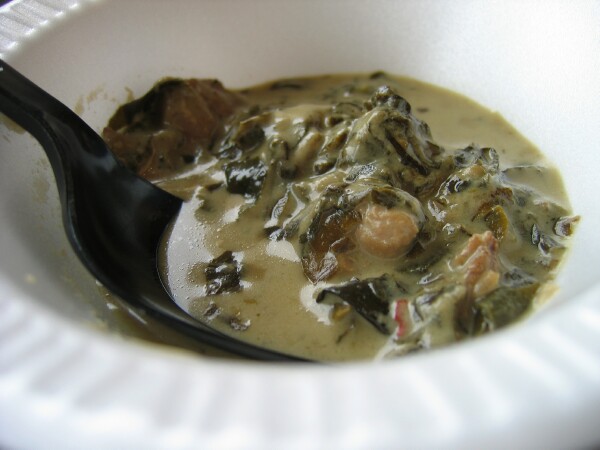
I ate taro leaves up to three times a day. What I liked was the leaves were always cooked in coconut cream. The finished dishes were so rich, oozing the goodness of coconut oil - the perfect way to conduct vitamin K into the body where it could work its magic.

Interestingly, the sun spots on my hands, ears and forehead which I have burned off by the dermatoligist every few years have all but disappeared from sight since being in the harsh Samoan sun. How could this be? I put this improvement down to improvements in diet, particularly to an increased uptake of the fat soluble vitamins - something I would not have to consciously think of doing if I were in Samoa, eating a traditional Samoan diet.