Gary's new website

Showing posts with label HTMA - arteriosclerosis. Show all posts

Monday, April 15, 2013

Report: Blood pressure surge 'alarming'


By Martin Johnston
5:30 AM Monday Apr 15, 2013
Fatal heart attacks likely to rise when linked with risks such as the obesity epidemic, warn researchers.
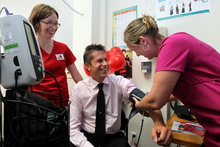
Compared with a 2002 Auckland study, average pressure had increased in most age/sex categories. Photo / Duncan Brown
EXPAND
Compared with a 2002 Auckland study, average pressure had increased in most age/sex categories. Photo / Duncan Brown
The average blood pressure of New Zealanders in middle life appears to have increased, an "alarming" finding that could contribute to a predicted rise in the heart attack death rate after a 40-year-long reduction.
Hypertension - abnormally high blood pressure - increases the risk of stroke, heart failure and heart-artery disease. It can also eventually damage the kidneys and eyes. High blood pressure can be caused by obesity, high intake of salt or alcohol, and lack of physical activity.
.......
In 2008/9 Mew Zealand adults ate 9g a day, unchanged from a decade earlier and well above the recommended maximum intake of 5.8g.
Under pressure
31 per cent of adults have abnormally high blood pressure
15 per cent report taking drugs to reduce blood pressure
35-54 year-old NZ Europeans and others - average blood pressure up since 2002
35-74 year-old Maori - average blood pressure up since 2002
Source: Otago University and 2008/9 Adult Nutrition Survey
http://www.nzherald.co.nz/lifestyle/news/article.cfm?c_id=6&objectid=10877548
_____________________________
Gary:
Elevated calcium = arteriosclerosis
Rising blood pressures is a concern.  However; medicating the problem and excessively restricting salt is not the solution and may actually cause a further reduction in health due to the many subtle side effects of medications.  Low salt may lead to confusion, fatigue, water retention and even osteoporosis.

Yes, there is far too much refined salt in the modern diet and this must be reduced.  The best way to reduce this is to avoid processed foods and fast foods as much as possible and replace these with good home cooking.

Replace refined salt with pink Himalayan salt

Compare the label of ingredients of pink salt with the list of elements on the hair tissue chart to the upper right and you will see a remarkable similarity:  They are almost the same!  Remarkable!  The salt of the Primordial Ocean (Himalayan) is very close to the mienral salts found in a healthy human cell - more or less.  I have discovered that pink salt appears to "normalise" blood pressure when used to replace refined salt.

Arteriosclerosis may be the most important driver of increasing blood pressure

This is the process of our gradually turning to stone: starting with the deposition of calcium in the arterial walls.  As the arteries calcify, they become increasingly inflexible, raising both systolic and diastolic blood pressures.

Have a look at the hair analysis chart above and you will note elevated calcium levels.  Low calcium, relative to magnesium is the pattern we look for that is indicative of the process of arteriosclerosis.  This pattern is present in about 80% of all hair tissue mineral analyses that I do, including children (early starters in the development of cardiovascular disease).

Incidentally, high calcium relative to potassium is the pattern that indicates a tendency for extreme fatigue and even depression.

Simply put: The problem of high blood pressure boils down to these:

  • Too much refined salt that has replaced the pink salt that has been used for thousands of years.
  • Too much calcium in the diet.
  • Not enough magnesium, other trace nutrients and nutritional cofactors.
Of course there are several other factors not to be ignored, such as being overweight, stress, smoking and lack of exercise; but the ones above are almost completely ignored.  Silly, really, because they do improve health!

More reading:


The advice in these articles is given freely without promise or obligation. Its all about giving you and your family the tools and information to take control of your health and fitness.

Tuesday, December 20, 2011

What causes spider veins and how can I prevent them?

Ankle spider veins
"The shorts have been out over the last 6 odd weeks and I have noticed what I think must be spider veins on my thighs mainly. 

My Mum had varicose veins below her knees and they are definitely not that although I do have dark thick veins around my shins that poke out a bit. The spider?? veins haven't caused me any discomfort and seem to come and go today you would hardly notice them. The look isn't great but I just wanted to check they weren't a sign of something I should be aware of?? 

Thank you for a year of steadily improving health, it is marvellous being a year oldre and feeling better."
Anon
______________________________
Gary:
HTMA recently taken for "Anon"
When viewing the Hair Tissue Mineral Analysis (HTMA) we can detect the suspected causes of spider veins.  Please refer to the chart (right) when reading the following.

When there is an excess of calcium relative to magnesium there will be a slow process of deposition of the excess calcium in the soft tissues, including the arteries and veins. This process may be accelerated when there is an imbalance between copper and zinc (a balance is necessary for strong collagen and, therefore, strong blood vessel walls) and where there is the presence of even tiny amounts of heavy metals - arsenic and mercury in this case. A lack of co-factors such as pyridoxine (B6) may also be present.

Toxic elements such as arsenic and mercury increase oxidative stress and bind with nutritional elements such as magnesium, zinc and selenium, rendering them unavailable.  The blood vessel walls are the first in line for the damage wreaked by these toxins.

A person's mineral imbalances, including the presence of toxic elements, may be inherited from their mother; but not their father.  This is inherited - not genetic.

Rakaia River, New Zealand
Spider veins are the first evidence of hardening of the arteries (arteriosclerosis).  If unchecked, this may lead to poor circulation to the limbs, high blood pressure, impotence, dementia, heart attack and stroke.  Being very tiny, the capillaries are easily damaged and blocked, becoming like the stagnant branches of a braided South Island river such as the Rakaia.  

This early damage is usually seen about the ankles and behind the knees and thighs.  Once a spider vein is formed, there is probably no going back - the ones you can see are there for good.  What you see just below the skin is also happening throughout the body - muscles, brain, heart, liver, etc. The most important thing now is to prevent this process continuing and effecting more vessels, including the large ones such as the aorta. 

There is no reason why this process of slowly turning to stone can not be reversed and flow improved through blood vessels that are still functioning.  Please read the articles here about reversing arteriosclerosis.

Prevention and reversal of this calcification process is a gradual exercise of balancing the nutrients in the HTMA and eliminating any hint of toxins in the body.  This involves modest dietary modifications, supplementation with a combination of vitamins and minerals, including adding antioxidants such as mixed beta carotenoids, selenium, vitamin E and vitamin C.  Each case is different and guided by their HTMA report.

_______________________________________
About this website
The advice in these articles is given freely without promise or obligation.  Its all about giving you and your family the tools and information to take control of your health and fitness.

Monday, August 15, 2011

More about reversing arteriosclerosis

Dear Gary,

Read your last mail subject ... with great excitement how did you do this as we are all told it is irreversible?
I have suffered with this condition since my mid 40s. I am now 67 still moving about but with restrictions.
Are you willing to share the knowledge because I would like to live something like a normal life as would many others with this condition?

"I"
_______________________________
Gary:
"I" is referring to this article about reversing arteriosclerosis.  Arteriosclerosis is the process of increasing stiffness of the arterial walls, principally through calcifying.  This is a dynamic process that can go either way.  If there is an excess of calcium in circulation in the presence of inflammation, this may drive the process of laying down of calcium deposits in the arterial walls and elsewhere - but not the bones.  This process can be reversed if inflammation is eliminated and the concentration of free calcium relative to other minerals is reduced.

Arteriosclerosis is a process that builds over decades, perhaps beginning within your first ten years of life, eventually presenting as an intractable disease (Poor circulation, high blood pressure, heart problems, stroke, dementia, arthritis).  These conditions are not really the cause - they are the result - the cause is inflammation and calcification.  Drugs that reduce blood pressure and calm the heart may be necessary to rescue a precarious situation; but they do not address the underlying causes - they merely rescue and quell the symptoms.  The underlying causes continue to wreak their damage with the inevitability that the drugs will no longer be able to keep the lid screwed tight - something, somewhere in the body will blow with catastrophic consequences.

The key to health success is to identify the underlying drivers of disease and then to reduce and, hopefully, eliminate them altogether.

Treat the causes of disease - not the symptoms

The first step to take is to get a Hair Tissue Mineral Analysis completed and to go through the report with me.  This test helps us see what is going on inside your cells and to compare your profile with that of healthy populations and people with similar health conditions.  Armed with this information, we then commence a programme of diet, supplements and lifestyle changes with the purpose of gradually nudging you towards the profiles of healthy populations.  The Hair Tissue Mineral Analysis will need to be repeated every 6-12 months to guide the programme.  Its actually quite a simple process but it does takes a huge amount of patience and persistence.

Reversing a process that may have been percolating away for decades can not be reversed overnight.

Yes! Success requires persistence and time - as well as being prepared to spend some money.  In addition to dietary changes each hair analysis costs about $220-$240 and there will be some supplements to take and these will amount to about $4-6 per day for as long as you can see and feel you are heading in the right direction.

A final point to make: Getting from poor health to good health is not a steady upwards climb; but more a series of lifts, dips and plateaus.  There may be times that you go backwards.  We all go through highs and lows of energy.  Right now, during the depths of winter, most of us tend to be less well than at other times of the year.  Some people describe it as being like walking up a very steep sand dune: Five steps up, four down, three up, five down, five up, two down and on and on and on it goes.  Hard work but well worth the effort over the long run.  No matter how long it takes, you will eventually make it to the top.

But what happens when you make it to the top?  Well, the cynic says there is only one way from there and that's down!  I like to be more positive: The challenge is to stay on top, if there ever is an actual "top".  The idea is to die healthy - a long time from now!


_______________________________________
About this website
The advice in these articles is given freely without promise or obligation.  Its all about giving you and your family the tools and information to take control of your health and fitness.  Please give me your support by subscribing to my free email updates. Please shop at my Online Store. Please encourage your family and friends to do the same. While we may not always be able to compete with the big operators on price, we aim to more than compensate through personal service!

Your email address:

Powered by FeedBlitz
Do you have a question?  Email Gary: gary@myotec.co.nz. Include any relevant background information to your question.  Please be patient and be aware that I may not be able to answer every inquiry in detail, depending on workloads (My paying clients take precedence!). I will either reply by email or, most likely, by way of an article (Personal identifying details will be removed before publication).