Gary's new website

Showing posts with label arterioscleosis. Show all posts

Monday, April 15, 2013

Report: Blood pressure surge 'alarming'


By Martin Johnston
5:30 AM Monday Apr 15, 2013
Fatal heart attacks likely to rise when linked with risks such as the obesity epidemic, warn researchers.
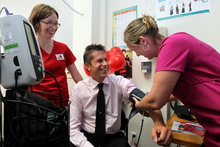
Compared with a 2002 Auckland study, average pressure had increased in most age/sex categories. Photo / Duncan Brown
EXPAND
Compared with a 2002 Auckland study, average pressure had increased in most age/sex categories. Photo / Duncan Brown
The average blood pressure of New Zealanders in middle life appears to have increased, an "alarming" finding that could contribute to a predicted rise in the heart attack death rate after a 40-year-long reduction.
Hypertension - abnormally high blood pressure - increases the risk of stroke, heart failure and heart-artery disease. It can also eventually damage the kidneys and eyes. High blood pressure can be caused by obesity, high intake of salt or alcohol, and lack of physical activity.
.......
In 2008/9 Mew Zealand adults ate 9g a day, unchanged from a decade earlier and well above the recommended maximum intake of 5.8g.
Under pressure
31 per cent of adults have abnormally high blood pressure
15 per cent report taking drugs to reduce blood pressure
35-54 year-old NZ Europeans and others - average blood pressure up since 2002
35-74 year-old Maori - average blood pressure up since 2002
Source: Otago University and 2008/9 Adult Nutrition Survey
http://www.nzherald.co.nz/lifestyle/news/article.cfm?c_id=6&objectid=10877548
_____________________________
Gary:
Elevated calcium = arteriosclerosis
Rising blood pressures is a concern.  However; medicating the problem and excessively restricting salt is not the solution and may actually cause a further reduction in health due to the many subtle side effects of medications.  Low salt may lead to confusion, fatigue, water retention and even osteoporosis.

Yes, there is far too much refined salt in the modern diet and this must be reduced.  The best way to reduce this is to avoid processed foods and fast foods as much as possible and replace these with good home cooking.

Replace refined salt with pink Himalayan salt

Compare the label of ingredients of pink salt with the list of elements on the hair tissue chart to the upper right and you will see a remarkable similarity:  They are almost the same!  Remarkable!  The salt of the Primordial Ocean (Himalayan) is very close to the mienral salts found in a healthy human cell - more or less.  I have discovered that pink salt appears to "normalise" blood pressure when used to replace refined salt.

Arteriosclerosis may be the most important driver of increasing blood pressure

This is the process of our gradually turning to stone: starting with the deposition of calcium in the arterial walls.  As the arteries calcify, they become increasingly inflexible, raising both systolic and diastolic blood pressures.

Have a look at the hair analysis chart above and you will note elevated calcium levels.  Low calcium, relative to magnesium is the pattern we look for that is indicative of the process of arteriosclerosis.  This pattern is present in about 80% of all hair tissue mineral analyses that I do, including children (early starters in the development of cardiovascular disease).

Incidentally, high calcium relative to potassium is the pattern that indicates a tendency for extreme fatigue and even depression.

Simply put: The problem of high blood pressure boils down to these:

  • Too much refined salt that has replaced the pink salt that has been used for thousands of years.
  • Too much calcium in the diet.
  • Not enough magnesium, other trace nutrients and nutritional cofactors.
Of course there are several other factors not to be ignored, such as being overweight, stress, smoking and lack of exercise; but the ones above are almost completely ignored.  Silly, really, because they do improve health!

More reading:


The advice in these articles is given freely without promise or obligation. Its all about giving you and your family the tools and information to take control of your health and fitness.

Thursday, July 14, 2011

More about Reversing Cardiovascular Disease Risk and Quality of Life

Far from being anti-doctor, I am all for them - with some reservations about specific treatments, as you would gather when reading my articles.  Anyway, I went to see my Dr, a long time acquaintance who completed the same University of Otago sports medicine course I went through.  It was several years since I last saw him - That was for a gashed forearm following an "unplanned dismount" off my bicycle!

It was time for a cardiovascular health check to see how the blood tests, etc matched with my Hair Tissue Mineral Analyses and general good health.

Please read what follows in conjunction with this article about reversing cardiovascular disease.  
I suggest that you read it first then come back to this one 
(there is a link back to here at the end of the the article).

My doctor is very good at telling me where I am while not necessarily the best at telling me how I got there.  So, where am I right now health-wise?

I now have records of blood cholesterol, blood sugar, body composition and blood pressure stretching back as far as 25 years.

During those years up until 5 years ago:
  • Blood pressure gradually crept upwards to about 130/90 and sometimes higher despite an increasingly low salt diet.
  • Cholesterol trended to unhealthy ratios despite an increasingly low cholesterol diet.
  • Muscle declined and fatness increased to about 16-17%.
  • And, of course, my general well-being and athletic performance did a steady dive!
Over the last five years I have progressively resorted to:
  • Liberally salting my food with Himalayan Salt.
  • I am currently eating up to six eggs every day (We have a friend with free range chickens), I eat the fat on meat, use butter and drink full cream milk daily (All in relative moderation and combined with physical activity).
  • I use dietary supplements daily as per the guidance from repeated Hair Tissue Mineral Analyses.
My latest medical tests as compared to 2002/3:
  • Body composition has body fat now at ~10% while muscle has increased by about 3kg.
  • Blood pressure in the Dr's surgery was 100/60 (A bit low in my opinion).
  • Blood sugar 5.0 (was 5.1)
  • Total Cholesterol is 5.8 (was 5.3)
  • Triglycerides 0.7 (was 0.9)
  • HDL Cholesterol 1.49 (was 1.07)
  • LDL Cholesterol 4.1 (was 3.9)
  • Chol/HDL ratio 4.0 (was 5.0)
Let me explain what these figures mean:

Blood sugar, insulin and body composition

As we get older, it is usual for insulin resistance to increase.  This may show as the blood sugar levels creeping upwards. What this means is we get poor at using fats and sugars.  Insulin resistance is regarded as one of the best measures of biological ageing as compared to chronological ageing.  This process of gradual decline shows as:
  • Increasingly fluctuating energy levels, 
  • Reducing physical endurance,
  • Food cravings,
  • Gaining fat, no matter what, about the hips and waist,
  • Increasing difficulty getting rid of belly and hip fat and
  • Loss of muscle and loss of strength.
  • Insulin resistance may lead to Type II Diabetes.
In my case, this trend of biological ageing has been reversed:
  • Blood sugar is a steady 5.0 despite being older,
  • I have increased muscle without a single visit to the gym,
  • Body fat has dropped and is very low for age and gender and
  • The time I can go on a bike without the need for sustenance has stretched from 2.5 hours to a remarkable 4+ hours.
  • Muscle power has increased dramatically.
Blood Pressure

As we get older, our arteries tend to become hardened, brittle and inflexible due to oxidative damage, calcium deposits and progressive clogging with fatty plaque.  These processes are present in at least 80% of the population, beginning from a very early age and will ultimately result in diseases such as:

  • Heart attack,
  • Stroke,
  • Impotence,
  • Diseases of dementia and
  • Arthritis.

This gradual process of declining circulatory health will show in the early stages as increasing blood pressure, decreasing maximum heart rate during extreme effort, decreasing physical performance, impotence, joint pain, cramping and brain fog.  The usual calculation for this if 220 beats per minute minus your age, so at 58 years, my maximum heart rate should be about 162.  The sooner the causes of this gradual decline are identified and corrected, the better your chances of success.

Here's the circulation facts for me:
  • Blood pressure is now120/80 or less,
  • Libido is at about where it was during my 20's,
  • Maximum heart rate is an impressive 180+ beats per minute and
  • I am riding "A" Grade in cyclocross racing which is just about as intense a cardiovascular sport you can get (There are "A", "B" and "C" Grades and the "A" is generously populated by some of the best in NZ). 
Cholesterol
  • Total cholesterol has increased.  This is healthy because cholesterols are the building blocks for cells and hormones.  Too little cholesterol and health fails terribly.  High cholesterol is healthy - so long as your body is turning it over fast and so long as the ratios between cholesterols are "healthy". Let me explain:
  • Triglyceride at 0.7 is very healthy and well below the threshold of 1.7.
  • HDL Cholesterol has increased to 1.49.  HDL is the protective form of Cholesterol and is now well above the threshold for healthy (>1)
  • LDL Cholesterol (the "unhealthy" one) has increased from 3.9 to 4.1; but this is offset by lower Triglycerides and higher HDL as follows:
  • The Cholesterol/HDL ratio (this is the important one) has improved from 5.0 to 4.0 (4.0 or lower is considered healthy).
According to my doctor, I am now in the bottom 5% of the population, for age and gender, for cardiovascular risk.

This is despite all of the extra salt, protein and fatty cholesterol that I have been eating over the last five years.  I will qualify this by saying that I have been generally very careful about choosing fresh, natural foods, home cooking, not over-indulging and exercising.

How did I get to where I am now?
  • Annual Hair Tissue Mineral Analysis.  This test has removed most of the guessing about what to eat and what supplements to take.  When repeated, it tells us where the action has been and what changes to make.  I could not have achieved what I have without this test.  (If you want my help with improving your health, you will probably need to get one of these tests completed and be prepared to repeat it annually).
  • Quality and targeted supplementation.  The key to supplementation is small amounts, often and for a long time.

Small amounts, often and for a long time

  • Going back to traditional foods and home cooking.  As a general rule of thumb: If it comes in a packet, has a long shelf life and needs minimal preparation, then leave it out - its not really food.  We seldom eat out and purchase raw food which is then prepared and cooked from scratch.  We grow vegetables and purchase from local farmers' markets.
  • Exercise is less than what I used to do and only as and when I feel like it.  I choose to ride a bike for now because it is gentle on joints (Depending on the dismounts!).
  • I am constantly seeking ways to reduce stress in my life.  This includes taking every opportunity to chill out on the balcony in natural light.  I now work from an office/clinic at home, employ nobody and we keep do not waste anything, including energy (Meaning we do not have to work long hours to pay for waste).  We take holidays at every opportunity with the theme of getting outdoors, into nature and exploring.
  • I expose my body to sunlight.  We are not meant to be cave dwellers. Sunlight is actually good for you.  My skin health has surprisingly improved since doing this and the sun is definitely invigorating and a wonderful antidepressant.

We are Creatures of the Light - Not of the Night

In summary:  

It is possible to reverse the processes of cardiovascular disease; but it takes time, a lot of patience, some money and scientific testing to guide you on your journey.

It is inevitable that our bodies will gradually fall into states of disrepair and eventually fail at which point our toes point upwards and we die.  For many people, this process of sad decline is well in hand by 30 years and gaining momentum.  Medically, the only hope is to last out the rest of life well preserved by an expensive concoction of toxic drugs!   But this is hardly my idea of  living and more like waving the white flag of surrender.

Death is more certain than being born and even more certain than paying taxes

It is a sobering fact that every person in human history eventually died.  This rather depressing inevitability does not mean that we should give up on trying to stay healthy as we age.  To the contrary, Life is throwing each and every one of us the challenge to see how long we can keep the wheels of our cellular machinery screwed on tight and well lubed.  Of course, this is one plan that is doomed to fail from the very beginning!  Before the beginning, in fact.

The Grand Plan is to die healthy - one morning to wake up  dead!

I, for one, am enjoying this, the most  vain of challenges.  You are welcome to tag along with me if you feel up to it!


_______________________________________
About this website
The advice in these articles is given freely without promise or obligation.  Its all about giving you and your family the tools and information to take control of your health and fitness.  Please give me your support by subscribing to my free email updates. Please shop at my Online Store. Please encourage your family and friends to do the same. While we may not always be able to compete with the big operators on price, we aim to more than compensate through personal service!


Your email address:

Powered by FeedBlitz
Do you have a question?  Email Gary: gary@myotec.co.nz. Include any relevant background information to your question.  Please be patient and be aware that I may not be able to answer every inquiry in detail, depending on workloads (My paying clients take precedence!). I will either reply by email or, most likely, by way of an article (Personal identifying details will be removed before publication).

Wednesday, June 29, 2011

Cardiovascular Disease (Arteriosclerosis) Reversed - Here is the evidence!

The Author (58 yrs) back on his bike.
Strong heart, strong circulation.
Evidence of magnesium malabsorptivity and  adrenal fatigue.
By age 50, my blood pressure was all over the place and I was consulting a cardiologist about an irregular pulse.  I was tired - damn tired!  In addition, my left knee was getting worse, two operations later.  On my 50th birthday my partner, Alofa, gave me a surf kayak.  She knew it and I got the message - my legs had had enough, I was tired and it was time for sit-down past-times.  Arthritis and cardiovascular disease were starting to rear their ugly heads in less than subtle ways.  If this was how I felt at fifty, how was I going to feel at sixty?  Seventy? Eighty?  I did not like the imagery going through my head.

Evidence of calcium (Ca) excretion: Ca in hair sample has doubled,
despite adoption of a low calcium diet!  Mg now being absorbed.
Getting worse before getting better:  Metabolism has
deteriorated from "Slow 3"to "Slow 4".
It was time for some serious intervention!  Several years on, I can report brilliant success.

Please read this article about cholesterol and cardiovascular disease in conjunction with what I have written below.

Slowing turning to stone
The principal driver of cardiovascular disease - leading to ailments like heart attack, stroke, loss of circulation to limbs, impotence, declining eyesight and dementia - is calcium deposition into soft tissues - including the blood vessels - aided by chronic inflammation (More about inflammation in a future article).

Ca has skyrocketed to an astonishing 215 from an original of 40 despite low
Ca diet!  Major Ca dump is occurring from soft tissues.  Blood pressure
has normalised.  Brain works better.  Aerobic capacity and
endurance have improved to where they were about 20 years ago.
This process of gradual calcification happens over decades and affects at least 80% of the New Zealand population.  It sneaks up on us. This leads to a number of ageing-related health issues, including osteoporosis, gall stones, weight gain, thyroid disorders arthritis and arteriosclerosis.  We are going to focus on arteriosclerosis in this  article.

My Hair Tissue Mineral Analyses, which now cover several years, show how I reversed this most unwanted process of gradually turning to stone.

Calcium dump from soft tissues continues, though at a lower level.
Mercury also continues to be excreted via the hair cells.  Sense of
well-being continues to improve, as do measure of cardiovascular
health.  Athletic performances defy age.
Arteriosclerosis is the deposition of calcium in the walls of the arterial blood vessels of the body.  This causes a gradual loss of flexibility and scarring of the blood vessels.  there is a progressive die-off of the tiniest of blood vessels (arterioles) and this may be seen as purple spider veins on the cheeks, chin, legs and ankles.  As this process of arterial calcification and tiny blood vessel die-off progresses, there is a gradual increase in blood pressure and a steady reduction of blood flow to the limb and organs, including the brain.  When your optometrist looks into the rear of your eyes, one of the things she is assessing is the health of the tiny blood vessels that nourish the retina: Arteriosclerosis causes a progressive die-off of these tiny vessels.  Arteriosclerosis explains why cardiovascular related ailments are the leading causes of disability and death in New Zealand.

Calcium dump continues.  Magnesium (Mg) by supplementation is being
 absorbed into the organs (Compare Mg levels with the first chart).
Mercury (Hg) continues to be excreted, but at much lower levels.
Health and athlete performance continue to improve, despite now
being several years older.
Arteriosclerosis happens when there is an imbalance of calcium circulating in the body relative to quite a number of nutrients, including magnesium, sodium, potassium, copper, zinc, phosphorus, selenium and various other nutrients including pyridoxine and vitamin D.


Toxins such as mercury and lead,  even in the tiniest amounts, may interfere with calcium metabolism, leading to calcium deposition in unwanted places like the joints and blood vessels.  High calcium plus toxic elements gives you a double whammy of calcium deposition.

Excess Calcium = Premature Ageing
If circulating calcium can not be properly utilised inside the cells, such as for bone, muscle and nerve function, it will end up precipitating into the spaces between the cells of the soft tissues, causing them to be clogged by chalk.  This chalkiness may contribute to transparent dry skin, fine wrinkles, brittle nails, lifeless hair and unsightly spider veins.  Deposition in joints drives arthritis.  Because excess calcium affects thyroid function, the affected person may feel very tired, suffer cold hands and feet, sleep restlessly and gain weight about the hips and waist. Libido may be poor to non-existent.

Reversing arteriosclerosis
Everything I have been taught, to date, is that the processes of arteriosclerosis are progressive and irreversible: All that can be done is to mask or alleviate the symptoms with drugs and surgery.  This is a bleak point of view: Dementia, impotence, stroke, heart attack, arthritis - inevitable?  We now know that this process of calcification can be halted and even reversed.  But it does take time and a whole lot of effort.

Please refer to the charts above: These document the commencement and the ongoing process of my body mobilising and then dumping excess calcium from my soft tissues over several years.  During this period, I have repeated the Hair Tissue Mineral Analyses about once a year to guide me as to what I should be doing with my diet and supplementation.

The first chart hints of the imbalances that drive the the process of calcium deposition into the soft tissues.  Dietary and supplement measures were then put in place to reverse this process and this appears in the next chart as improvements in the uptake of Mg and other minerals and an associated dump of excess calcium commencing. The third chart show this dumping gather astonishing pace, while the fourth and fifth charts show that the calcium dump has peaked and is now in decline but still continuing to this day.

The process of "detoxification" can bring about periods of discomfort when it may be that you feel you are going backwards.  In my case, when I look at the big picture of progress overall, since 2007, the gains have been absolutely amazing!  I feel half my age and the stop watch does not lie - My athletic performance is at least as good as it was during my 30's.  Incidentally, I am carrying more muscle than I did back then which is unusual because muscle is lost as we get older - and this despite no longer working out in a gym.

Here are some of the things I have noticed have improved since 50 years:

Libido
A good measure of general health, including circulation is libido which, for me, is at least as good as it was decades ago; but that's as much detail as you're going to get out of me!

Cholesterol 
I have been keeping an eye on my cholesterol for over 20 years and it has been steadily creeping up, even despite being on a cholesterol lowering diet.  For the first time ever, cholesterol levels have started to trend down.  And this is despite my quadrupling my intake of fats and proteins during the same period!


Skin Kerastoses
I used to visit the dermatologist about once every two years to get precancerous skin kerastoses burned off - there has been no need for the last five years because they have all dropped off or faded away!

Joint Arthritis
My left knee is close to 100% pain free and functional which is miraculous.  It should be getting worse at my age - not better.  I am able to ride a bike and run competitively without discomfort or limitation.

Blood Pressure
My blood pressure at 50 years was all over the place, often above 150/90 and at times less than 100/60.  It is now consistently about 120/80 and I can fell the difference.

Pulse
I did consult a cardiologist about ten years ago regarding an excessively low pulse and irregular rhythm.  At one point, my peak pulse in a lab stress test was 109 beats per minute!  Normal maximum pulse is 220- Your Age, so I was in trouble back then.  Both these issues have completely resolved in line with what is indicated in the Hair Tissue Analysis Reports; but the real proof is the regaining of my sporting Mojo in quite spectacular fashion.  My peak heart rate during exercise is now slightly over 180 beats per minute which is excellent for my age and there are very few veteran male athletes in New Zealand who can outdo me on the cardiovascular stamina front.

The Challenge Ahead
This exercise of improving and maintaining good health is never finished because the natural processes of ageing dictate that one's physiology must eventually fall into terminal disrepair, resulting in death.  The challenge is to keep the wheels of the machinery of life bolted on tight and turning despite the ravages of time and life itself.  Of course, this exercise of staying healthy gets more difficult as time passes.  Depressing as it might be to think about these matters, I actually find it to be a fascinating challenge.

My goal is to die healthy, quickly and with a smile.  Hopefully I will wake up one morning only to discover I am dead.  Hopefully that is many years away!

Please read this article about cholesterol and cardiovascular disease in conjunction with what I have written above.

_______________________________________
About this website
The advice in these articles is given freely without promise or obligation.  Its all about giving you and your family the tools and information to take control of your health and fitness.  Please give me your support by subscribing to my free email updates. Please shop at my Online Store. Please encourage your family and friends to do the same. While we may not always be able to compete with the big operators on price, we aim to more than compensate through personal service!


Your email address:

Powered by FeedBlitz
Do you have a question?  Email Gary: gary@myotec.co.nz. Include any relevant background information to your question.  Please be patient and be aware that I may not be able to answer every inquiry in detail, depending on workloads (My paying clients take precedence!). I will either reply by email or, most likely, by way of an article (Personal identifying details will be removed before publication).

Tuesday, May 17, 2011

Read this before your child ends up on Ritalin

Rosy cheeks, indicative of magnesium
deficiency which is widespread due to
high consumption of refined foods.
"Thank you for your advice and knowledge shared regarding magnesium and zinc deficiency. My three year old daughter who could not sit still and who would flit from one toy to another and would give trouble at bed time is now playing for extened lengths of time with her toys and is settling to sleep without much fuss. Her Kindigarten teachers have also remarked that XYZ is sitting well on the mat these days.

The MagnaPower that you provided is so easy to use and add to XYZ's diet.

I 've really been enjoying the increased calmness and pleased to be minimising for XYZ any adverse effects caused by magnesium/zinc deficiency.

Thanking you,

"C"
______________________
Gary:
This beautiful little girl was a bit like a mini-hurricane on the first occasion I met her.  She would not sit still, was loud, had her fingers in everything and I could tell her mother was quite exhausted and frustrated by this wee whirlwind.  Mind you, she is not unusual of children nowadays - just ask any primary or kindy teacher!

Chronic magnesium deficiency - Death of
tiny blood vessels in cheeks and chin.
Same process taking place throughout the
body including eyes, brain, heart, liver,
muscles, etc.
On examination, there was the tell-tale hint of rosiness on her cheeks.  Rosy cheeks is what I call the "Heidi Syndrome" and is due to an excess of calcium (usually from dairy and breakfast cereals) and deficiency of magnesium (Due to high intake of refined grains - noodles, pasta, muesli bars, rice, etc).  This deficiency is widespread in about 80% of all people I test and appears to be more widespread in children due to the extreme of calcium and deficiency in magnesium in foods that are marketed to children.

What we decided upon was to give her a high potency magnesium powder which her mother was to hide in a fruit drink 2-3 times daily.  Children have remarkably responsive metabolisms and, in her case, the improvement in her was apparent within a week.  After just three weeks, the change was remarkable: She sat in my room and played with her Grandmother, read and generally kept herself amused.  When it was time to go, she went outside and sat on a chair, on her own, while the adults chatted - remarkable!
High calcium relative to magnesium, creating a relative
magnesium deficiency.

Deficiency of magnesium, either absolute, or relative to calcium, is associated with numerous conditions, including: Hyperactivity, noise sensitivity, insomnia, allergies, hyperthyroidism, seizures/epilepsy, kidney dysfunction, parathyroid dysfunction, cramps, colitis, diverticulosis, arteriosclerosis, diabetes, alcoholism, adrenal hyperactivity, excessive perspiration, arteriosclerosis, heart attack, stroke and dementia.

Why does magnesium deficiency cause rosy cheeks?  Healthy blood vessel tone is dependent upon adequate levels of magnesium.  If there is insufficient magnesium the smooth muscle in the vessel walls will cramp, causing congestion/pooling of blood in the tissues (blood pressure may rise).  The more it pools, the more deoxygenated the blood which goes from pink to red to purple.  This process, while obvious in the cheeks, is also going on in every organ of the body.  If this continues year after year, the blood vessels will begin to die off, leaving purple/red spider veins which are most obvious on the cheeks, chin, ankles and back of the legs.  Your optometrist will see the same process happening inside the eyes.  The same happens in the brain (dementia).

Stress, be it physical, emotional or chemical, using up bucket-loads of magnesium (and other nutrients).  Stress will cause an acute need for magnesium and this will show as the cheeks going a brighter red.  You can observe this when a wee child has a tantrum, a teething baby, or children playing soccer.  The same is seen when an adult is stressed/angry and when embarrassed (blushing).  This is not so obvious in an older person possibly due to the blood vessels being less responsive due to the cumulative damage over the decades.  In older people, we have to look more carefully and look for dead veins.

A Calcium rich diet and supplementation is inappropriate for at least 80% of people, including children, due to relative deficiencies in magnesium.  Most dietary corrections involve reducing calcium intake while increasing magnesium intake.  In most cases, dietary supplementation of magnesium and other nutrients is needed and should be continued for as long as there are any visible signs of deficiency (rosy cheeks).  Exactly what is going on and what is the best course of action is best done by way of a Hair Tissue Mineral Analysis.


_______________________________________
About this website
The advice in these articles is given freely without promise or obligation.  Its all about giving you and your family the tools and information to take control of your health and fitness.  Please give me your support by subscribing to my free email updates. Please shop at my Online Store. Please encourage your family and friends to do the same. While we may not always be able to compete with the big operators on price, we aim to more than compensate through personal service!


Your email address:

Powered by FeedBlitz
Do you have a question?  Email Gary: gary@myotec.co.nz. Include any relevant background information to your question.  Please be patient and be aware that I may not be able to answer every inquiry in detail, depending on workloads (My paying clients take precedence!). I will either reply by email or, most likely, by way of an article (Personal identifying details will be removed before publication).

Monday, August 02, 2010

Study finds link between calcium supplements and increased heart attack risk

500 mg calcium supplement tablets, with vitami...Image via Wikipedia

"While experts are not certain about the biological mechanism by which calcium supplements may damage the body, studies in the past have linked high levels of blood calcium to more heart attacks and damage to blood vessels", Reid said.


_____________________________________
Gary:
The findings of this study are not new news really and stopping taking calcium supplements, while being a beneficial action for most, will do little to improve the overall situation of population risk of heart attack, stroke, dementia and so on.  There is just far too much calcium in the modern diet.


Calcium from any source, when in excess, will damage health


High calcium, low magnesium = Calcification of soft
tissues, including arteries.  Plus osteoporosis.

When calcium is in excess relative to other nutrients in the body, such as magnesium, sodium, copper, protein and pyridoxine, then it will not go into the bones, but be deposited into the soft tissues including the arteries. Whether the imbalance is due to excess calcium intake, deficiency in others or increased need, the end result is the same: Hardening of the soft tissues.


Excess calcium will cause osteoporosis, not prevent it. When a nutrient is in excess the body is unable to incorporate the nutrient and may, in fact go into excretory mode


Wednesday, August 29, 2007

Does cholesterol cause heart disease, or is it Vitamin C deficiency?

RESULTS: We found strong inverse trends for blood ascorbate concentrations with all-cause and cardiovascular disease mortality, which were only marginally reduced after adjustment for confounders or supplement use. Those in the lowest fifth (<> 66 micromol/L) had a mortality risk nearly half that (hazard ratio = 0.54; 95% CI: 0.34, 0.84). Similar results were found after the exclusion of those subjects with cardiovascular disease or cancer at baseline (hazard ratio = 0.51; 0.28, 0.93). In fully adjusted models, there was no evidence for an influence of alpha-tocopherol, beta-carotene, or retinol on total mortality. Dietary antioxidants measured by the food-frequency questionnaire were not associated with all-cause or cardiovascular disease mortality.

CONCLUSION: Low blood vitamin C concentrations in the older British population are strongly predictive of mortality.

Am J Clin Nutr. 2003 Nov;78(5):999-1010.
____________________________________
Gary Moller comments:
The research literature is increasingly peppered with research studies like the one above. The focus of heart disease prevention in recent decades has been on lowering blood cholesterol levels; but has this been misguided?

Fact:
Cholesterol is essential for life. It is an important substance used by the body to make steroid hormones such as estrogen, and testosterone and it accounts for one half the dry weight of the brain. Cholesterol is present in all the cell membranes. When cholesterol is reduced too low you get blood sugar problems, oedema, mineral deficiencies, chronic inflammation, and difficulty in healing, allergies, asthma, reduced libido, infertility, depression and brain fog - to name some!

When cholesterol levels plummet with a fat free diet and medication, so does the person's health.
Serum Cholesterol levels below 160 mg/dL (below 4.1 mmol per liter) are considered sub-optimal (persons with sub-optimal Cholesterol levels have a greater incidence of Stroke, Lung Ailments, some types of Cancer and Alcoholism).

It may be that it is the byproducts of oxidised cholesterol that does the damage to arterial walls, leading to arteriosclerosis and consequent heart attack or stroke. The key to heart health may be in strategies to prevent fat oxidation in the circulating blood. This is achieved by having a diet that is rich in antioxidants beginning with vitamin C. As reported in the study above, vitamin C has a cardio protective effect. About 1-2,000 mg per day would appear to be about right.