Gary's new website

Showing posts with label HTMA - Athlete. Show all posts

Sunday, May 18, 2014

What on earth is "Neurocardiogenic Syncope"?


Cyclist emerges from coma - National - NZ Herald News
WWW.NZHERALD.CO.NZ
Triathlete Laurent Vidal has emerged from an induced coma and is showing signs of making a positive recovery from a heart attack suffered in training at the weekend. 


"He was eventually diagnosed with neurocardiogenic syncope, a nerve problem that causes a sudden drop in blood pressure".

"Neurocardiogenic syncope" is a fancy way of saying he fainted as a result of a problem with the nerves that activate the heart.  This condition is remarkably similar to Addison's or Adrenal Fatigue which is epidemic among athletes.  In fact, this was the topic of my lecture tour of Australia last year, "Running on Empty".  Unfortunately, mainstream medicine still refuses to recognise any condition called "Adrenal Fatigue".  Their refusal to recognise this condition may be because it is successfully treated by nutrition and lifestyle modifications - not high value patent drugs and surgery.

"Neurocardiogenic syncope" is just a big word for describing what happened.  Nowhere in the Herald article is there anything about root causes, just symptoms.  Modern medicine treats symptoms - not root causes.  This is yet another example of failing to identify the root causes of ill health.

You can not drug a person into good health - drugs merely suppress symptoms


When one looks closely at the nutritional status of many athletes like marathon runners, cyclists and triathletes, a disturbing pattern appears:  MALNUTRITION!   Many of these athletes really are running on empty!   Some look like they are starving themselves to death and careful analysis of their diet and bodily nutrient stores (Hair Tissue Mineral Analysis) usually confirms this.  Have a close look at the photo above of Laurent Vidal and his fiancee Andrea:  He actually looks like an old man, despite being just 30.  Athletes can be very, very fit while also being very unwell.

Being in a state of nutrient starvation may be complicated by a triathlete or swimmer being exposed daily to large amounts of toxic halides such as chlorine, fluorine and bromine in swimming and spa pools.  These halides, in the presence of low iodine, directly interfere with thyroid function which then impacts on adrenal function.  The adrenals regulate the excitement of the nervous system, blood pressure and heart function.  The adrenals drive high-octane sports performance as well.  

When the adrenals fail to respond to stress, due to overuse and depletion of nutrients (adrenal fatigue), the athlete will collapse - faint and maybe even die.  Sounds like "neurocardiogenic syncope", if you ask me!


About this website 
The advice in these articles is given freely without promise or obligation. Its all about giving you and your family the tools and information to take control of your health and fitness.
Candida and Fungal Infections? Gary Moller recommends you explore this programme: Click Here!

Tuesday, March 26, 2013

Updated: Running on empty - why athletes eventually run out of gas

Alastair Leslie in the lead (Rod Dixon in 3rd)
Why is it that elite athletes have roughly ten years of peak performance in them after which the  slow decline begins?  

If an athlete starts training hard at 16, he or she will peak several years later, then slowly decline from their late 20's.  If they start at 30, they will peak 5-10 years later and then begin their slow decline.  Veteran New Zealand runners like Jack Foster and John Campbell are good examples.  Despite being late-comers to the international running scene, both set several world class times in their late 30's and 40's.  Both had a good ten to fifteen years at the top before gradually losing form.

While some of this decline is due to the inexorable processes of ageing, this is not entirely the case as is indicated by the extraordinary careers of late starters such as Foster and Campbell.

Let me explain what I think happens as athletes get older by referring to the case of former national level runner, Alastair Leslie (Alastair has given permission for his personal information to be used in writing this article).

Alastair winning comfortably ahead of
 Liam Healey
As a 16 year old, Alastair Leslie was one of New Zealand's most promising middle distance track athletes. Coached by the legendary  Arthur Lydiard, Alastair turned out a number of impressive performances between 1975 and 1990:
  • 100m - 11.6s
  • 400m - 50.5s
  • 500m - 1:51.07
  • 1500m - 3:44.60
  • Mile - 4:02.28
  • 5,000m - 14.11
  • Alastair with his coach,
    Arthur Lydiard
  • Half marathon - 1hr 7minutes.
He raced John Walker, Rod Dixon and other international stars of the 80's before beginning the inevitable slow decline into exhaustion from which he has never recovered.  Now 52 years old, Alastair is still feeling distinctly tired -"burned out" - and struggling to exercise enjoyably.  Rest has not made the problem go away.

Alastair looks remarkably fit and healthy.  However, he has tell-tale signs that all is not well - Such as not handling stress quite as well as he might have in the past, insomnia, dry thin skin, poor exercise capacity and constantly tired.  He feels like he is "Running on Empty".

Alastair's Hair Tissue Mineral Analysis (HTMA) highlights several nutrition factors, other than ageing, that may be contributing to his "Tired Athlete" condition.

High HTMA zinc and chromium in the presence of low manganese and
molybdenum, may actually be losses of these minerals (Zn and Cr)
 from the body stores and therefore indicate deficiency.
Alastair's HTMA (right) is typical of those for tired athletes - He really is running on empty - Most nutrients appear to be precariously low - Ideally, each being within the "Reference Range".
Training with Keith Livingstone, author of
the book, "Healthy, Intelligent Training"
Circa 1980
Low magnesium (Mg) and calcium (Ca) may compromise muscle and nerve function.  Low sodium (Na) and potassium (K) indicate poor adrenal function and possibly thyroid and blood pressure problems.  Low copper (Cu) relative to zinc (Zn) and low manganese (Mn) may lead to weak connective tissue, brittle bones and an unhealthy cholesterol profile.  High chromium (Cr) to manganese is associated with insulin resistance and problems with blood sugar regulation. There is more; but I am sure you get the point: There's a lot going on!

Of interest is the presence of mercury (Hg) and lead (Pb).  This is a common finding, presumably due to the contamination of our environment and food chain through the increasing use of chemicals, metals and the burning of fossil fuels.  Mercury, in this case, is probably due to eating canned tuna most days, rather than via dental amalgam.  Lead contamination can be from many sources, including stripping off old paint during home renovations.  Low adrenal and thyroid function may turn a person into and "accumulator" of toxins, rather than being an "excretor"

Lead and mercury bind with nutritional elements such as zinc, iron, calcium, selenium and magnesium, rendering them unavailable for biological use.  Mercury's effect on selenium (Se) and zinc, for example, interferes with their role of protecting skin cells from UV damage and preventing chronic inflammation. This process may be a precursor to many cancers, including breast and prostate cancer.
Alastair in winning form

My experience with the HTMA is that people in New Zealand and Australia who work with their hands tend to have elevated arsenic, presumably from working with arsenic treated timber. This may partially explain soaring rates of prostate cancer which seems to be affecting tradesmen and farmers more than others.

Alastair's HTMA profile is indicative of trends towards depression and fatigue.  It is hardly a surprise if a person is tired and grumpy when they are running on empty.

We can conclude from Alastair's HTMA that a good deal of what he may be attributing to ageing is actually somewhat controllable.

Alastair owns BodyShape Fitness Studio
Tawa, Wellington
Alastair is gradually restoring his health and running "mojo" through a personalised programme of nutritional balancing. His HTMA helps to take out the guessing of what foods and nutrients to include or exclude. It will be repeated at regular intervals to monitor his progress and to fine tune the programme.

Thanks Alastair for allowing us to share your story.


_______________________________________
About this website
The advice in these articles is given freely without promise or obligation.  Its all about giving you and your family the tools and information to take control of your health and fitness.

Saturday, August 25, 2012

Chronic fatigue in a group of elite swimmers

Some athletes are treated like working donkeys;
thrashed day in - day out.  Then they are expected
to race the Grand National Steeples
during the weekends!
The London Olympics are over and still New Zealand celebrates its wonderful medal haul. However; behind the celebrations there will be many disappointed Kiwi athletes, many will be emotionally and physically exhausted, some angry, some feeling let down and all wondering, "Why - Oh why did I fail to fire after all these years of preparation?"  Some of the more disappointed athletes will be from our swimming team, most of whom failed to fire on the day.  Most did not even do a personal best.

In this article we are going to study the health of four elite swimmers, three male and one female, who are on the cusp of representing New Zealand.  It is they who must now step up to the plate and replace the swimmers who are now going into retirement.  But there is one very big hurdle in front of all four of these apparently healthy people:  They are exhausted and three of them are struggling with chronic illness.  Despite all appearances, they are not well.  How could this be?

I am not surprised because they are typical of the swimmers who come through my door: Fit-looking young men and women by all appearances; but underneath is a dead-tired and often ill person who is struggling to get through each day.  When they describe their training programmes, they remind me of a poor Palestinian donkey.

Hi Gary,
Thank you so much for the reassurance to XXXX.  Initially he didn’t want me to take any action re his training, but after we had met with his coach he did say “thanks for that mum”.  Not that I said much I was just there to support him and make sure he wasn’t overridden by a driven coach who seems to lose sight of the fact that they are human beings and not race horses (in fact I think horses probably get a better deal, at least they get put out to rest!!)
(The writer is the mother of an exhausted elite swimmer)

These swimmers are often doing grueling swimming programmes up to 30 hours a week, sometimes more.  Because of their physical talents they will be pressured to play school sports, such as rugby and netball.  On top of this they must go to school or university and/or work full or part-time - and still find rest and energy to grow through puberty!   Impossible!

I am not criticising coaches

I was talking to Alastair Leslie, a former national level middle distance runner and now coaching a number of very good runners, mostly female.  He made a few observations that got me thinking about why there appears to have been such a dramatic decline in training capacity in youngsters today as compared to 30 or so years ago?

Back in the 1970's and early 80's when NZ had an almost unlimited number of world-class running athletes to pick and choose from, it was par for the course that these young men and women would run 100 miles or more for several weeks as part of their seasonal preparation.  There were few sports physios and sport doctors back then and not that much demand for them.  Sports orthotics were unheard of before 1980 and running shoes were little more than glorified plimsolls.  Today, few  can sustain anything like that without suffering disabling injuries or chronic illness requiring constant medical attention.  Breakdown may happen with as few as 30 miles per week.  What has changed?

I think what has changed is mostly to do with what we are feeding our kids.  Our foods have changed dramatically.  Most of our processed food has been altered and pumped with all kinds of chemicals to prolong its shelf life and improve its taste.  Unless it is brought fresh, the food on the shelf is essentially "dead".  Food and animals are grown on increasingly depleted soils.  Chicken and pork, for example, are little more than reconstituted corn and corn is little more than reconstituted super phosphate.

The standard food of the modern child is the instant noodle.  Where's the nutrients?

High calcium - low fat foods weaken bones.  No wonder athletes of today break down with just a fraction of the physical workloads of yesterday!  Refer here:
http://blog.garymoller.com/2012/01/inconvenient-truth-about-osteoporosis.html

And: http://blog.garymoller.com/2011/07/about-female-runners-and-stress.html

While swimmers are not subjected to high impact forces, they are expected to crank out extraordinary distances in a toxic environment (more about this later).   Nutrient imbalances, excesses and deficiencies are the norm (more about this below).

What this all adds up to is athletes with a limited capacity for training and a tendency to under-perform when it is most needed.

It is therefore hardly a surprise to me that a swimming coach who trained and competed during the "good old days" may appear to be asking too much of the talented young swimmer and may come across as being increasingly frustrated with the lack of results.

Why do swimmers, in particular, end up being chronic under performers? 


Here are the Hair Tissue Mineral Analysis reports of four elite swimmers
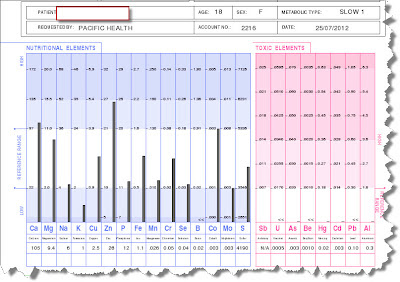
Exhausted female swimmer (NZ age group record holder) unable
 to swim for several weeks due to chronic chest infection.
Each one of the gifted young men and women, that are represented in these Hair Tissue Mineral Analysis reports, is on the cusp of internal representation.  One or two of them may have made the London Olympics if it was not for one thing:  They are chronically tired to the point of being ill!

(Please note that the swimmers represented in these reports have consented to me using their cases for this article).


Elite swimmer who is dead tired, always yawning and unable to
keep awake during the day.
I won't go into great detail about each individual report, or give any detail beyond age and gender, to protect the privacy of the swimmers.

Interpreting a Hair Tissue Mineral Analysis is complex and takes years of study and working with this test to fully understand the "ins and outs" of interpretation; But there are a couple of basic rules to bear in mind when eye-balling the main Nutritional Nutrients Chart.

Firstly, all of the nutrient bars for a healthy person, regardless of age, should be within the white "reference range".  Secondly, one does not want a chart which has a mix of "skyscrapers and valleys.  It is better to have all the bars high or low.

Exhausted age group record holder swimmer with chronic airways
infections and about to undergo nasal and sinus surgery.
Elite swimmer suffering "post-viral" fatigue
The complex patterns represented by the varying concentrations of minerals from the hair samples can be correlated with physiological functions within the body.  For example, elevated copper and calcium is strongly associated with low thyroid function. High calcium relative to potassium is strongly associated with chronic fatigue.  Varying levels of sodium and potassium are associated with varying degrees of adrenal fatigue.  Low molybdenum is associated with asthma and other lung disorders.  Low manganese is associated with cholesterol problems as well as joint and ligament disorders such as Osgood-Schlatters.  The list is long, as are the number of inter-relationships.  Toxic elements, such as mercury are like the Jokers in the pack - Their actions can be unpredictable and they always cause metabolic chaos.

What is seen in the charts of our tired elite swimmers is the bars are all over the place.  Few of the bars are in the reference range and each swimmer has a mix of skyscrapers and valleys. These are not healthy profiles.  There is a lot going on in these swimmers.


Here are some - but not all - of the patterns that are present in these reports:


  • Elevated calcium, relative to potassium and elevated copper, are the classic patterns for extreme fatigue.
  • High calcium is associated with thyroid disorders and sleep disturbances.
  • An imbalance between calcium and magnesium is associated with neurotransmitter disturbances, muscle cramps and heart irregularities.
  • Low phosphorus, especially in the presence of high calcium, is associated with poor mitochondrial function and a tendency to osteoporosis.
  • Low or elevated sodium and potassium are indicative of various stages of adrenal exhaustion.
  • Elevated zinc in the presence of low molybdenum is associated with viral, yeast and fungal infections.
  • Elevated iron relative to copper is indicative of a chronic infection and a resultant condition known as "infectious anaemia".
  • Elevated chromium relative to manganese is associated with cracking joints and ligaments, diseases such as Osgood-Schlatters and Perthes, as well as metabolic disorders affecting fat, protein and glucose metabolism.
  • Toxic elements such as arsenic, cadmium, mercury and aluminium interfere with just about every level of cell metabolism and are highly inflammatory - even when present in the tiniest amounts - Just a few parts per million is sufficient to cause metabolic chaos.

A swimmer who is trying out for Olympic representation does not want even one of these tendencies, let alone half a dozen or more!

These reports may come across as deeply depressing and the immediate reaction of the reader may be to say; "Give up!"  But I interpret each one of these profiles as "Performance Potential" or the glass being half full, rather than half empty.  If these young swimmers have done as well as they have with all this stuff going on then imagine just how much better they will perform once we have cleaned the slate of all this metabolic chaos?

Are swimming pool chemicals the cause of fatigue in elite swimmers?


Fluoride, chlorine and bromine are common pool chemicals.
These sit atop iodine and may interfere with iodine's
critical functions within the body.
Some of the elements found in pool chemicals are a factor in swimmer fatigue and ill-health.  The elements to focus on are the group of elements on the Periodic table known as the Halides.

These are fluorine, chlorine and bromine.  Fluorine is now added to most municipal water in New Zealand and this is what fills our swimming pools.  Chlorine is found in municipal water and extra is added to swimming pools as a disinfectant.  Bromine is used to sterilise water, particularly spa pools.

Included in the Halides family is iodine which, you will note, sits underneath the others.

Iodine for metabolism 

Iodine is required for healthy thyroid function and health in general.  Iodine has important anti-cancer properties.   Lack of iodine is implicated in breast and prostate cancer.  Iodine deficiency is associated with some connective tissue disorders.  Some studies have iodine deficiency in countries like New Zealand as high as 90% of the population.

As mentioned earlier, fluorine, chlorine and bromine sit atop iodine in the Periodic Table of Elements.  Each of these halides can be thought of as being "Iodine Bullies".  These bullies push iodine out of the thyroid and they crowd and consequently block the thyroid hormone receptors present on the surfaces of cells.  The consequence is thyroid dysfunction often felt as extreme fatigue, depression, aching muscles, poor muscle tone, poor immunity, cold hands, cold feet and weight gain, especially about the hips and waist.

Swimming pool water is not a very healthy medium to be soaking in daily!


When reviewing the health histories of elite swimmers, there are consistent patterns of fatigue and chronic illness.  There are high rates of glandular fever (Epstein Barr virus), yeast and fungal infections, sinus and chest infections.  When you look at their Hair Tissue Mineral Analyses, you see patterns that confirm this history of chronic ill-health and under-performance.

Elite swimmers may spend 20-30 hours per week bathed in a chemical solution of two or more of these harmful halides.  In addition, they breathe the air which also contains these substances and do so at a rate many times greater than a person at rest.  And most have been exposed to this environment since childhood.  It is therefore hardly a surprise to then encounter a succession of tired and ill swimmers.

As far as I know, every swimming pool in New Zealand is chemically treated and few are outdoors.

An outdoor pool would presumably be healthier in terms of the concentration of the harmful halides in the air.  A salt water pool, such as found at Bondi Beach, Australia, presumably has no chemical treatment.  One would assume that people who swim in outdoors saltwater pools will have a better standard of health, including showing little of no signs of ill-health associated with exposure to the harmful halides.

Interventions to improve the health of our four swimmers


Each of our swimmers has differing needs.  One, for example, is terribly infected and about to undergo quite major surgery on his sinuses.  All of them need nutritional therapy to offset the toxic effects of chlorine, fluorine and bromine.  All need to increase their intake of protein and a range of fats.  All of them need much more zinc and co-factors due to zinc metabolism problems.  All of them must cut back on calcium intake and increase their magnesium intake.

All four swimmers need more rest to ensure better recovery between training.  Their biggest gains in swimming performance will come from less time spent in the pool, more time resting and more effort balancing their nutrient intakes.

When it comes to training for swimmers:

Less is more!


I think too much time is being spent grinding out the miles in the pool day in - day out.  When tired, even the quality sprint sessions are not really "quality".  A fresh swimmer will train with better quality and be more consistent over the season due to few, if any, breaks due to illness and injury.  They will enjoy swimming more than ever and be less likely to give up.
I will be publishing updates on the progress of these four talented swimmers.  Our goal is to get all of them to the next Olympics.  This is a realistic expectation.  We have less than two years to get them right.  We will do it!
_______________________________________
About this website
The advice in these articles is given freely without promise or obligation.  Its all about giving you and your family the tools and information to take control of your health and fitness.

Saturday, June 23, 2012

A once very fast runner halted by an unexplained case of calf pain


Lorraine Moller winning
London Marathon 1980
"Good morning I am French from Montpellier,I have 53ans today; I am coach himself with the principles of A.LYDIARD since 1984. 


In 1985 I made 15 ' 04 " / 5000m, then 14 ' 40 " in 1986 in 1987 I was hill, in 1988 2h24' ', then 2h21' in 1989. In 1990 j was stopped by a wound the origin of which we have never found I was hardly I gained(won) a competition of very good level and dices the next day I had my left leg very very heavy to the effort; I made of numerous examination and I eventually made(eventually was made,eventually happened,eventually was) 2years after operated for the syndrome of muscles legs but without result); 


I think today that my probleme was purely mechanical but nobody knew how to see; With internet we are lucky magnifical to be able to communicate with people like you which(who) was friend to A.L for which I had a very big admiration. Can be had you a case similar to mine in your knowledge? 


In any case thank you and bravo for your blog. Be you the husband of Lorraine Moller? Has the time(period) in 1984 I had seen her marathon AVON in Paris. remember...... sincerely yours Jeff"
___________________________
Gary:
Jeff, Wow!  You were a fast runner!  You must be very frustrated not being able to run freely anymore.

Jeff: Me be not the husband of Lorraine Moller.  She be my younger sister.

While I do not have a photo of her winning Paris, the photo above is of her winning the London Avon Marathon in 1980.  I have asked her if she has one from the Paris Marathon.

The calf problem you describe is an interesting one that I have encountered many times, mostly in runners, so your inquiry is timely for writing an article.

Blood is returned to the heart almost
exclusively by muscle contraction.
Unexplained calf muscle pain/dysfunction with feelings of heaviness may be due to poor circulation through the muscle.  This may be due to a combination of factors which I will explain as best I can....

At rest, the circulation of blood through muscle and back to the heart is from the action of the heart.  As activity begins and increases, the rhythmic contraction and relaxation of the muscles progressively takes over the role of returning blood back to the heart.  So, when an athlete is exercising at maximum heart rate, one can presume that that muscles are almost exclusively responsible for flow back to the heart, while the heart is responsible for the flow from the heart to the muscles.

An athlete with healthy blood vessels and pliable muscles will find their heart revs quickly in response to exercise.

With repeated extreme exercise that may span over many years, the muscles become hard and scarred.  This is in marked contrast to the soft and pliable muscles of a well-conditioned young person.  A soft, pliable muscle will be engorged with oxygen rich arterial blood when in the relaxation phase of exercise.  When it contracts, the blood will be forcefully and fully ejected towards the heart.

Muscle that is hardened and scarred will be increasingly resistant to filling with fresh arterial blood.  This may be seen as an increase in systolic blood pressure during rest and as exercise intensity increases. The heart must contract with excess force to get the blood into the muscle.  When the muscle contracts only a small amount of blood is ejected.  The heart will be slower to respond to exercise stress.

This may partly explain why an older athlete's heart is slower to respond to exercise demands.  What typically happens when the gun goes off is the young runners take off like bullets, while the older runners tend to gradually wind into the race and, hopefully, mow down the youngsters as the race progresses.

A further factor in the loss of circulation, heaviness and pain may be the gradual process of blockage of the blood vessels that carry blood to and from the legs.  This may occur at the groin or the back of the legs.  This may include tearing and scarring.  Please refer here: http://blog.garymoller.com/2012/06/kiwi-women-are-dying-of-broken-hearts.html.  Zinc deficiency is as good as universal in athletes.

Jeff, I am assuming that the surgery you had was decompression of the calf muscle.  Here's an article about this syndrome that I wrote in 2007: http://blog.garymoller.com/2007/11/tibial-compartment-syndrome-in-running.html  While surgery may have given temporary relief, I am not surprised it has been of no long term benefit.  


This problem may typically occur after an intense run in a pair of unfamiliar shoes, such as switching to spikes or racing flats, doing hill-bounding, track work or a road race.  Something like this may have set off the first episode of feeling very, very heavy in the calf muscle.  That earlier run causes acute spam of the calf, and consequent muscle damage with consequent swelling and, therefore an increase in pressure within the muscle.  The restricted blood flow that results will cause the leg to feel very heavy and non-functional when trying to run the next day.

The remedy for your calf muscle dysfunction may be quite simple really!

Here's the action I recommend:

Get a weekly deep tissue massage of the calf muscles

This is painful for the first 3-4 sessions but this should ease dramatically with regular sessions.  Each session will last about an hour with attention focusing on any areas that feel hard or deformed within the muscle belly.  The muscle will quickly soften and, with each session, blood flow through it will improve.

Get these essential nutrients into your body

The muscles need massive amounts of magnesium and co-factors in order to function properly, including to relax and contract.  You may also need vitamin C and zinc.  A Hair Tissue Analysis removes the guessing as to what nutrients an athlete needs.

Question: Should you wear compression stockings or tights?

No! In my opinion - unless you have bad varicose veins.  Tight stockings do not allow the calf muscles to fully engorge with oxygen-rich arterial blood, due to the compression effect of the stockings during the relaxation phase of contraction.

If there was a survival advantage from having tight skin, then natural selection would have it that all creatures that require the combination of speed and endurance for survival, including Human Beings, would have natural, inbuilt compression tissues in their skin - The fact is they don't and the reason is clear - tight enclosures of muscle compromises circulation.


_______________________________________
About this website
The advice in these articles is given freely without promise or obligation.  Its all about giving you and your family the tools and information to take control of your health and fitness.

Thursday, July 14, 2011

More about Reversing Cardiovascular Disease Risk and Quality of Life

Far from being anti-doctor, I am all for them - with some reservations about specific treatments, as you would gather when reading my articles.  Anyway, I went to see my Dr, a long time acquaintance who completed the same University of Otago sports medicine course I went through.  It was several years since I last saw him - That was for a gashed forearm following an "unplanned dismount" off my bicycle!

It was time for a cardiovascular health check to see how the blood tests, etc matched with my Hair Tissue Mineral Analyses and general good health.

Please read what follows in conjunction with this article about reversing cardiovascular disease.  
I suggest that you read it first then come back to this one 
(there is a link back to here at the end of the the article).

My doctor is very good at telling me where I am while not necessarily the best at telling me how I got there.  So, where am I right now health-wise?

I now have records of blood cholesterol, blood sugar, body composition and blood pressure stretching back as far as 25 years.

During those years up until 5 years ago:
  • Blood pressure gradually crept upwards to about 130/90 and sometimes higher despite an increasingly low salt diet.
  • Cholesterol trended to unhealthy ratios despite an increasingly low cholesterol diet.
  • Muscle declined and fatness increased to about 16-17%.
  • And, of course, my general well-being and athletic performance did a steady dive!
Over the last five years I have progressively resorted to:
  • Liberally salting my food with Himalayan Salt.
  • I am currently eating up to six eggs every day (We have a friend with free range chickens), I eat the fat on meat, use butter and drink full cream milk daily (All in relative moderation and combined with physical activity).
  • I use dietary supplements daily as per the guidance from repeated Hair Tissue Mineral Analyses.
My latest medical tests as compared to 2002/3:
  • Body composition has body fat now at ~10% while muscle has increased by about 3kg.
  • Blood pressure in the Dr's surgery was 100/60 (A bit low in my opinion).
  • Blood sugar 5.0 (was 5.1)
  • Total Cholesterol is 5.8 (was 5.3)
  • Triglycerides 0.7 (was 0.9)
  • HDL Cholesterol 1.49 (was 1.07)
  • LDL Cholesterol 4.1 (was 3.9)
  • Chol/HDL ratio 4.0 (was 5.0)
Let me explain what these figures mean:

Blood sugar, insulin and body composition

As we get older, it is usual for insulin resistance to increase.  This may show as the blood sugar levels creeping upwards. What this means is we get poor at using fats and sugars.  Insulin resistance is regarded as one of the best measures of biological ageing as compared to chronological ageing.  This process of gradual decline shows as:
  • Increasingly fluctuating energy levels, 
  • Reducing physical endurance,
  • Food cravings,
  • Gaining fat, no matter what, about the hips and waist,
  • Increasing difficulty getting rid of belly and hip fat and
  • Loss of muscle and loss of strength.
  • Insulin resistance may lead to Type II Diabetes.
In my case, this trend of biological ageing has been reversed:
  • Blood sugar is a steady 5.0 despite being older,
  • I have increased muscle without a single visit to the gym,
  • Body fat has dropped and is very low for age and gender and
  • The time I can go on a bike without the need for sustenance has stretched from 2.5 hours to a remarkable 4+ hours.
  • Muscle power has increased dramatically.
Blood Pressure

As we get older, our arteries tend to become hardened, brittle and inflexible due to oxidative damage, calcium deposits and progressive clogging with fatty plaque.  These processes are present in at least 80% of the population, beginning from a very early age and will ultimately result in diseases such as:

  • Heart attack,
  • Stroke,
  • Impotence,
  • Diseases of dementia and
  • Arthritis.

This gradual process of declining circulatory health will show in the early stages as increasing blood pressure, decreasing maximum heart rate during extreme effort, decreasing physical performance, impotence, joint pain, cramping and brain fog.  The usual calculation for this if 220 beats per minute minus your age, so at 58 years, my maximum heart rate should be about 162.  The sooner the causes of this gradual decline are identified and corrected, the better your chances of success.

Here's the circulation facts for me:
  • Blood pressure is now120/80 or less,
  • Libido is at about where it was during my 20's,
  • Maximum heart rate is an impressive 180+ beats per minute and
  • I am riding "A" Grade in cyclocross racing which is just about as intense a cardiovascular sport you can get (There are "A", "B" and "C" Grades and the "A" is generously populated by some of the best in NZ). 
Cholesterol
  • Total cholesterol has increased.  This is healthy because cholesterols are the building blocks for cells and hormones.  Too little cholesterol and health fails terribly.  High cholesterol is healthy - so long as your body is turning it over fast and so long as the ratios between cholesterols are "healthy". Let me explain:
  • Triglyceride at 0.7 is very healthy and well below the threshold of 1.7.
  • HDL Cholesterol has increased to 1.49.  HDL is the protective form of Cholesterol and is now well above the threshold for healthy (>1)
  • LDL Cholesterol (the "unhealthy" one) has increased from 3.9 to 4.1; but this is offset by lower Triglycerides and higher HDL as follows:
  • The Cholesterol/HDL ratio (this is the important one) has improved from 5.0 to 4.0 (4.0 or lower is considered healthy).
According to my doctor, I am now in the bottom 5% of the population, for age and gender, for cardiovascular risk.

This is despite all of the extra salt, protein and fatty cholesterol that I have been eating over the last five years.  I will qualify this by saying that I have been generally very careful about choosing fresh, natural foods, home cooking, not over-indulging and exercising.

How did I get to where I am now?
  • Annual Hair Tissue Mineral Analysis.  This test has removed most of the guessing about what to eat and what supplements to take.  When repeated, it tells us where the action has been and what changes to make.  I could not have achieved what I have without this test.  (If you want my help with improving your health, you will probably need to get one of these tests completed and be prepared to repeat it annually).
  • Quality and targeted supplementation.  The key to supplementation is small amounts, often and for a long time.

Small amounts, often and for a long time

  • Going back to traditional foods and home cooking.  As a general rule of thumb: If it comes in a packet, has a long shelf life and needs minimal preparation, then leave it out - its not really food.  We seldom eat out and purchase raw food which is then prepared and cooked from scratch.  We grow vegetables and purchase from local farmers' markets.
  • Exercise is less than what I used to do and only as and when I feel like it.  I choose to ride a bike for now because it is gentle on joints (Depending on the dismounts!).
  • I am constantly seeking ways to reduce stress in my life.  This includes taking every opportunity to chill out on the balcony in natural light.  I now work from an office/clinic at home, employ nobody and we keep do not waste anything, including energy (Meaning we do not have to work long hours to pay for waste).  We take holidays at every opportunity with the theme of getting outdoors, into nature and exploring.
  • I expose my body to sunlight.  We are not meant to be cave dwellers. Sunlight is actually good for you.  My skin health has surprisingly improved since doing this and the sun is definitely invigorating and a wonderful antidepressant.

We are Creatures of the Light - Not of the Night

In summary:  

It is possible to reverse the processes of cardiovascular disease; but it takes time, a lot of patience, some money and scientific testing to guide you on your journey.

It is inevitable that our bodies will gradually fall into states of disrepair and eventually fail at which point our toes point upwards and we die.  For many people, this process of sad decline is well in hand by 30 years and gaining momentum.  Medically, the only hope is to last out the rest of life well preserved by an expensive concoction of toxic drugs!   But this is hardly my idea of  living and more like waving the white flag of surrender.

Death is more certain than being born and even more certain than paying taxes

It is a sobering fact that every person in human history eventually died.  This rather depressing inevitability does not mean that we should give up on trying to stay healthy as we age.  To the contrary, Life is throwing each and every one of us the challenge to see how long we can keep the wheels of our cellular machinery screwed on tight and well lubed.  Of course, this is one plan that is doomed to fail from the very beginning!  Before the beginning, in fact.

The Grand Plan is to die healthy - one morning to wake up  dead!

I, for one, am enjoying this, the most  vain of challenges.  You are welcome to tag along with me if you feel up to it!


_______________________________________
About this website
The advice in these articles is given freely without promise or obligation.  Its all about giving you and your family the tools and information to take control of your health and fitness.  Please give me your support by subscribing to my free email updates. Please shop at my Online Store. Please encourage your family and friends to do the same. While we may not always be able to compete with the big operators on price, we aim to more than compensate through personal service!


Your email address:

Powered by FeedBlitz
Do you have a question?  Email Gary: gary@myotec.co.nz. Include any relevant background information to your question.  Please be patient and be aware that I may not be able to answer every inquiry in detail, depending on workloads (My paying clients take precedence!). I will either reply by email or, most likely, by way of an article (Personal identifying details will be removed before publication).

Friday, February 25, 2011

How to slash your times in the Coast to Coast Multi-sports Race


Martin Leighton crossing Goat Pass at pace
"...managed to do a shade under 13 hours and had a day that went pretty much according to plan.  I think I was 32nd overall, and 21st in my category.  Pretty stoked with the result, particularly after the disappointment of last year.

The only thing I really battled with throughout the day was cramp.  I got it in my hammies and quads coming off the first bike and it stuck around for about the first 30-40mins of the run.  The old magic Cramp Stop spray kept it at bay for the rest of the day but I would be keen to try and understand what I can do to prevent this in future." 
Martin Leighton (Adventurer)

Coast to Coast website.
Martin Leighton in commanding form
___________________________________
Gary:
Congratulations Martin on what must be the "most improved of the year".

Just to give you an idea of how spectacular Martin's improvement in form has been consider this:

This year
  • 12hours 59mins 26secs
  • 32nd overall
  • 28th Male
  • 21st Open man
Last year
  • 14hours 28mins28secs – on the Plan B course that was about an hour quicker than this year’s original course. 
  • 160th overall
  • 138th Male
  • 99th Open Man.
 I first met Martin when he came to me for assistance with a chronic knee injury that had him reduced to paddling and aqua-jogging.  He was unable to run or cycle without pain.  This was not a good situation at the time of his programme which should have him cranking out peak miles in all three Coast to Coast disciplines (Cycle, run, paddle).

The underlying cause of his injury was evident:  Physical exhaustion, including nutrient imbalances that were leading to poor healing.  This was confirmed by the results of a Hair Tissue Analysis (Refer Chart left).  The pattern present in the chart is typical of adrenal exhaustion.  The high zinc relative to everything else, especially copper is indicative of a zinc metabolism disorder that can lead to poor healing and increasing soft tissue fragility, including the tendons and ligaments.

On examination, his muscles (Arms, legs, shoulders, buttocks and back) were found to be riddled with painful knotting and inflammation.  This is typical of adrenal exhaustion.

Martin immediately commenced a programme of deep tissue massage to free his muscles, along with dietary changes and nutrient supplementation to address the underly imbalances and deficiencies as identified with the Hair Tissue Analysis.

To Martin's credit, he took on every piece of advice and spared no expense in getting things right (Time was of the essence with the Coast to Coast in the first week of February!).

He was cycling the next day and cautiously into running (Rest longer than about three days is usually counterproductive to recovery in the case of most injuries of non-violent causes).

As we moved closer to the date of the Coast to Coast, the dietary supplements were adjusted to be increasingly focused on supporting athlete performance - the ability to sustain high work outputs over an extended time and to aid fast recovery.  I am not saying specifically what we did for Martin because the mix of diet and supplements varies according to an individual athlete's needs.  There is no "one-size-fits-all" formula.

The result of all this work is that Martin had a remarkable restoration in energy, his knee injury simply disappeared and he went on to blow away last year's performance.

So what caused the leg cramps at the beginning of Martin's run?
The key to doing the perfect race is pacing: Winding steadily into the race in such a way that the aerobic systems can keep up, not unduly force the body into glycogen-wasting anaerobic metabolism, and maintaining a pace which has the athlete completing the second half of each leg of the race slightly faster than the first.

This is not easy to do with the pre-dawn start of the Coast to Coast being a mad dash over the dunes to the bikes and then a mad scramble to get into the leading bunches before settling down (yeah right!) for the majority of the first cycle leg which just happens to be an over-extended climb up into the Southern Alps!

The consequence of all this intense effort is severe depletion of muscle glycogen, especially of the thighs.  This will lead to cramping of the depleted muscles if ongoing effort is little more than about 50% of full effort.  The tendency to cramp may lessen with time as lactate is gradually cleared from the muscles and circulation and some glucose is returned to the muscles via digestion and resynthesis of lactate by the liver.

Prevention is best.  Martin did everything right nutrition-wise; but missed out on one essential for preparation: Racing on bikes!  Cycling, like swimming and paddling are unusual in that the only way to really condition the body for the intensity of races is to race.  It is very difficult to race harden the body for the extremes of racing by individual training on its own.  If Martin had participated in a series of intense cycle club races then he would have breezed through the first section of the Coast to Coast, with less depletion of critical energy reserves.  In addition to the physical hardening that comes with bike racing, the rider gains invaluable experience of working efficiently within a peleton - a master of smooth acceleration, energy conservation and one revolution ahead of the rest with regards to tactical decisions.  What I am talking about in the way of racing is track racing and short, intense 20-40km road races.

_______________________________________
About this website
The advice in these articles is given freely without promise or obligation.  Its all about giving you and your family the tools and information to take control of your health and fitness.  Please give me your support by subscribing to my free email updates. Please shop at my Online Store. Please encourage your family and friends to do the same. While we may not always be able to compete with the big operators on price, we aim to more than compensate through personal service!
Your email address:

Powered by FeedBlitz
Do you have a question?  Email Gary: gary@myotec.co.nz. Include any relevant background information to your question.  Please be patient and be aware that I may not be able to answer every inquiry in detail, depending on workloads (My paying clients take precedence!). I will either reply by email or, most likely, by way of an article (Personal identifying details will be removed before publication).

Friday, December 03, 2010

Moller Family wins the Taupo Huka 80km mountain bike relay race

Alofa cycling to victory
Yes, its official folks - we won!

Not without there first being an official investigation of the result.  You see, at 57 years old I should not be finishing the first leg (40km) in 1hr 49m, 40 minutes ahead of the next relay rider.  In fact, I caught the tail end of the Pro Elite riders who had started a 20 minutes ahead of me. I should not have been hammering over 99% single track averaging over 20km/hr. Not at my age anyway.


"Act your age Moller!"


Alofa put in a solid performance, despite repeatedly dropping her chain, to hold on for the win by about seven minutes.

So, there was an investigation into a "timing irregularity" which has delayed us announcing the results.

Alofa and I are the winners.  Its official: I did not cheat - No shortcuts.

Thank you Rex and your team at Rocket Bikes, Kilbirnie, Wellington, for the great mechanical support and technical advice which you have given us over the last two years.  Alofa and I are racing on Merida 96 mountain bikes purchased from Rocket Bikes.

These winning performances confirm that I have turned the clock back by about 30 years and Alofa is cranking along very well also.  I am definitely in better cardiovascular and muscular health than I was in my 20s.  The stop watch does not lie.

This is further confirmation of the effectiveness of the scientific application of the ICL Hair Tissue Mineral Analysis, plus our own special kind of body work.

And, did you know this: I am doing much less training nowadays as compared to what I used to do.  This process of recovery of health and rebuilding strength began at about 50 years age and is ongoing.

The goal is to die healthy - A long time from now!

For an athlete to perform consistently well over many years, the first rule is he/she must be healthy - Do so and the performances will come - Naturally.

_______________________________________
About this website
The advice in these articles is given freely without promise or obligation.  Its all about giving you and your family the tools and information to take control of your health and fitness.  Please give me your support by subscribing to my free email updates. Please shop at my Online Store. Please encourage your family and friends to do the same. While we may not always be able to compete with the big operators on price, we aim to more than compensate through personal service!
Your email address:

Powered by FeedBlitz
Do you have a question?  Email Gary: gary@myotec.co.nz. Include any relevant background information to your question.  Please be patient and be aware that I may not be able to answer every inquiry in detail, depending on workloads (My paying clients take precedence!). I will either reply by email or, most likely, by way of an article (Personal identifying details will be removed before publication).

Saturday, April 03, 2010

47 year old female with chronic hamstring pain


Hi Gary


Five months ago i pulled a hamstring in right leg at the very top of hamstring. Previously i had low back pain and hamstring pain in both legs.Had seen a osteopath for 2 treatments and physio who said i had weak hamstrings but very flexible.

I have tried deep tissue massage,dry needling , anti inflammatories with very little success.Have now got pain in sit bones on both sides, lower back on right side feels tight . Can walk but can do little else.Swimming uncomfortable and cycling but can do both as long as low intensity.Previous to all this i was running half marathons always been active mountain biking,running, walking i am

Moller Brothers Win "Over 40 years" team race in 2010 Porirua Grand Traverse in record time


That makes four starts in the last 12 months, four wins and three course records in the over 40 year old teams duathlon and triathlon categories in three of the best multisports races in New Zealand and Australia.

The latest was the Porirua Grand Traverse last weekend in which we were defenders of the over 40 years triathlon and course record holders.  Each of us (Bruce, Gary, Gordon - photo) completed our respective legs faster than ever. 

The outstanding performance of the day was Bruce who paddled the course a full 15 minutes faster than last year to come in well under one hour and in second fastest paddler on the day!

We broke our previous M40 record by a staggering 20 minutes, finishing 6th fastest out of the entire field.

Monday, February 22, 2010

Feedback plus: "I have now developed a very sore point just in front of my right ankle"

Hi Gary
This is just a brief e-mail to say thankyou for the information you have placed on your web site. In particular, I have found the Super Smoothie of incredible value. Approximately 3 years ago, I was training for the Christchurch Marathon and was up around the 18 - 20 K mark each run in training. I ran the Taupo Half as a build up (1hr 36 - stoked) but a week later broke my ankle. It took me 12 months before I could run freely again without pain.

However, as I began training again I developed incredibly painful calf muscles and essentially was unable to run (could hardly walk) for the best part of 2 years.