Gary's new website

Showing posts with label HTMA - fatigue. Show all posts

Friday, January 24, 2014

Is sea salt really good for you? (updated)

Lorraine Moller: In need of a long, cold
drink - and a little salt - following her Bronze Medal
performance in the Barcelona Olympic
Marathon.
Hi Gary,
I cut right back on salt intake quite a few years ago thinking it was more healthy, but now I'm starting to think this might be wrong!


I've read of a few runners who overcame Adrenal gland burnout by taking SEA SALT!


Could my low Max Heart Rate and feeling weak and dizzy when I stand up quickly be caused by not taking enough salt! Is sea salt really good for you?


As a distance runner following Lydiard's base training I must be sweating out buckets of salt and trace
minerals.


Any advice would be much appreciated.
Thanks Rick

______________________________
Gary:
Good questions, Rick.

Humans have salt receptors on their tongues.  Its because without salt, we die.  Salt helped found civilisations when it was traded for cloth and grains. Roman soldiers were paid in salt which was then used to purchase goods (hence the word "salary").

The problem is that we have adulterated salt by refining it to be just one salt - sodium chloride (NaCl).  Natural salt consists of 80 or more different mineral salts with NaCl being the principal one. On its own, NaCl may be considered detrimental to health by causing imbalances between itself and the other salts that are found inside the healthy cell. Refined NaCl salt is what is added during modern food processing.

Pink Himalayan salt is at least 240 million years old.  It is what remains of the Primordial Ocean, the ocean from which creatures emerged to colonise the land.  Our cells have a salt make-up that is remarkably similar to the primordial ocean.  Our tissue salt make-up is quite different to the salt content of the oceans of today.  I find this most fascinating - that we have managed to retain, more or less, the salt make-up of the oceans within which higher life evolved many millions of years ago.

For this reason, I encourage the consumption of Pink Himalayan Salt and the avoidance of all other salt.  If pink salt is not available then Celtic salt is a good alternative.

There are three fluid compartments inside the body: These are the blood, the water surrounding the cells ("extracellular matrix") and the water inside the cells ("intracellular matrix").  Your trillion or so cells are like individual plants bathed in a hydroponic mix (extracellular matrix), with the nutrients and water (blood) supplied by millions of pipes (blood vessels).  The most important compartment, if there is one, is the intracellular matrix where the complex biochemistry of life happens.

Water follows the salt in the body.  How much water is in a compartment depends on how much or how little is needed to ensure the near perfect concentration of the complex salt solution necessary to maintain life. If there is an excess of NaCl relative to other salts, then the body will attempt to dump this excess NaCl through the kidneys and via sweating.  This will result in dehydration in all three fluid compartments, especially in the intracellular matrix.

Water and nutrients are actively transported across the semi-impervious cell membranes by there being a greater concentration of sodium on the outside relative to the potassium on the inside.  If this mechanism is unable to function well due to a mineral deficiency or excess then the processes that nourish and cleanse the cells begins to faulter.  The cell may become dehydrated and metabolic toxins will begin to accumulate in the intra and extracellular compartments.  Paradoxically, the extracellular matrix may become bloated with excess water.  These may be felt and seen as:

  • Oedema or bloating, often apparent as swelling of the feet and hands.  In skinny people, look for the tell-tale indentation from the elastic of ankle socks towards the end of the day.
  • Heavy, tired legs.
  • Feeling faint when standing up quickly.
  • Low blood pressure.
  • High blood pressure.
  • Slow, unresponsive pulse
  • Difficulty getting up to maximum heart rate.
  • Confusion, poor memory, anxiety.
  • Fibromyalgia and polymyalgia.
  • Adrenal fatigue.
  • Poor healing.
  • Prone to infections.
  • Physical and mental burn-out.
All of the above are very common in athletes and signals the beginning of the end of their competitive career.  Few competitive athletes avoid the symptoms above ("burn-out").

The solution is to take about one rounded teaspoon per day of pink salt.  If doing a lot of sweating, then more salt needs to be taken.  Add it liberally to food.  You also need to take in a little protein about every 2-4 hours of waking.  This can be any form including a protein smoothie drink.  The adrenals need salt and protein in order to do their job which includes regulating blood pressure.

Feeling light-headed?
Feeling faint upon arising is the cue to take three-four grains of coarse Himalayan Salt.  Just toss them into the mouth and wash down with a large glass of water.  If you get a nauseous feeling you need to drink more water. Have something to eat, including a little protein.

If you are depleted in minerals it can take many months, if not years, to fully replenish and balance levels and it may be necessary to give extra amounts of minerals such as magnesium, zinc and selenium.  It may also be necessary to supplement with nutrients such as pyridoxine which assists in the balancing of minerals including sodium and potassium as well as promoting red blood cell production, nerve function and balancing various hormones.

Just what is needed and how best to go about replenishing and balancing these is complex and best guided by the Hair Tissue Mineral Analysis (HTMA) and repeated the test every 6-12 months.  I recommend that all athletes use this test to guide their nutrition and to avoid burn-out.


_______________________________________
About this website
The advice in these articles is given freely without promise or obligation.  Its all about giving you and your family the tools and information to take control of your health and fitness.  Please give me your support by subscribing to my free email updates. Please shop at my Online Store. Please encourage your family and friends to do the same. While we may not always be able to compete with the big operators on price, we aim to more than compensate through personal service!


Your email address:

Powered by FeedBlitz
Do you have a question?  Email Gary: gary@myotec.co.nz. Include any relevant background information to your question.  Please be patient and be aware that I may not be able to answer every inquiry in detail, depending on workloads (My paying clients take precedence!). I will either reply by email or, most likely, by way of an article (Personal identifying details will be removed before publication).

Tuesday, March 26, 2013

Updated: Running on empty - why athletes eventually run out of gas

Alastair Leslie in the lead (Rod Dixon in 3rd)
Why is it that elite athletes have roughly ten years of peak performance in them after which the  slow decline begins?  

If an athlete starts training hard at 16, he or she will peak several years later, then slowly decline from their late 20's.  If they start at 30, they will peak 5-10 years later and then begin their slow decline.  Veteran New Zealand runners like Jack Foster and John Campbell are good examples.  Despite being late-comers to the international running scene, both set several world class times in their late 30's and 40's.  Both had a good ten to fifteen years at the top before gradually losing form.

While some of this decline is due to the inexorable processes of ageing, this is not entirely the case as is indicated by the extraordinary careers of late starters such as Foster and Campbell.

Let me explain what I think happens as athletes get older by referring to the case of former national level runner, Alastair Leslie (Alastair has given permission for his personal information to be used in writing this article).

Alastair winning comfortably ahead of
 Liam Healey
As a 16 year old, Alastair Leslie was one of New Zealand's most promising middle distance track athletes. Coached by the legendary  Arthur Lydiard, Alastair turned out a number of impressive performances between 1975 and 1990:
  • 100m - 11.6s
  • 400m - 50.5s
  • 500m - 1:51.07
  • 1500m - 3:44.60
  • Mile - 4:02.28
  • 5,000m - 14.11
  • Alastair with his coach,
    Arthur Lydiard
  • Half marathon - 1hr 7minutes.
He raced John Walker, Rod Dixon and other international stars of the 80's before beginning the inevitable slow decline into exhaustion from which he has never recovered.  Now 52 years old, Alastair is still feeling distinctly tired -"burned out" - and struggling to exercise enjoyably.  Rest has not made the problem go away.

Alastair looks remarkably fit and healthy.  However, he has tell-tale signs that all is not well - Such as not handling stress quite as well as he might have in the past, insomnia, dry thin skin, poor exercise capacity and constantly tired.  He feels like he is "Running on Empty".

Alastair's Hair Tissue Mineral Analysis (HTMA) highlights several nutrition factors, other than ageing, that may be contributing to his "Tired Athlete" condition.

High HTMA zinc and chromium in the presence of low manganese and
molybdenum, may actually be losses of these minerals (Zn and Cr)
 from the body stores and therefore indicate deficiency.
Alastair's HTMA (right) is typical of those for tired athletes - He really is running on empty - Most nutrients appear to be precariously low - Ideally, each being within the "Reference Range".
Training with Keith Livingstone, author of
the book, "Healthy, Intelligent Training"
Circa 1980
Low magnesium (Mg) and calcium (Ca) may compromise muscle and nerve function.  Low sodium (Na) and potassium (K) indicate poor adrenal function and possibly thyroid and blood pressure problems.  Low copper (Cu) relative to zinc (Zn) and low manganese (Mn) may lead to weak connective tissue, brittle bones and an unhealthy cholesterol profile.  High chromium (Cr) to manganese is associated with insulin resistance and problems with blood sugar regulation. There is more; but I am sure you get the point: There's a lot going on!

Of interest is the presence of mercury (Hg) and lead (Pb).  This is a common finding, presumably due to the contamination of our environment and food chain through the increasing use of chemicals, metals and the burning of fossil fuels.  Mercury, in this case, is probably due to eating canned tuna most days, rather than via dental amalgam.  Lead contamination can be from many sources, including stripping off old paint during home renovations.  Low adrenal and thyroid function may turn a person into and "accumulator" of toxins, rather than being an "excretor"

Lead and mercury bind with nutritional elements such as zinc, iron, calcium, selenium and magnesium, rendering them unavailable for biological use.  Mercury's effect on selenium (Se) and zinc, for example, interferes with their role of protecting skin cells from UV damage and preventing chronic inflammation. This process may be a precursor to many cancers, including breast and prostate cancer.
Alastair in winning form

My experience with the HTMA is that people in New Zealand and Australia who work with their hands tend to have elevated arsenic, presumably from working with arsenic treated timber. This may partially explain soaring rates of prostate cancer which seems to be affecting tradesmen and farmers more than others.

Alastair's HTMA profile is indicative of trends towards depression and fatigue.  It is hardly a surprise if a person is tired and grumpy when they are running on empty.

We can conclude from Alastair's HTMA that a good deal of what he may be attributing to ageing is actually somewhat controllable.

Alastair owns BodyShape Fitness Studio
Tawa, Wellington
Alastair is gradually restoring his health and running "mojo" through a personalised programme of nutritional balancing. His HTMA helps to take out the guessing of what foods and nutrients to include or exclude. It will be repeated at regular intervals to monitor his progress and to fine tune the programme.

Thanks Alastair for allowing us to share your story.


_______________________________________
About this website
The advice in these articles is given freely without promise or obligation.  Its all about giving you and your family the tools and information to take control of your health and fitness.

Saturday, February 16, 2013

Swimming: Glassford overcomes pool chemical issues

Matthew Glassford: 'My life feels so much better now.' Photos by Alistair McMurran.
Matthew Glassford wanted to become an elite international swimmer and came to Dunedin from Alexandra six years ago to fulfil his dream.
He was dedicated and trained hard, initially under the guidance of Duncan Laing and for the last five years with Osca coach Gennadiy Labara.
Progress became slow and had come to a dead stop last year. He contemplated giving up the sport.
''My teeth were going chalky and my muscle growth was halted,'' Glassford said.
''I wanted to get my sinuses sorted out. My nose was constantly running and it was filling my lungs with junk.
''I had very low energy and was always tired. I couldn't do anything and was burning out.''
It was at this stage that his mother, Karen Glassford, intervened and helped her son get his swimming back on track.
Glassford's cousin is international mountain biker Samara Shepherd, who was having similar energy and motivational problems.
Wellington health consultant Gary Moller watched her compete at a mountain bike competition, recognised her problem, and said he could help. Moller's treatment worked for Shepherd and she has been contracted to a professional mountain bike team in Belgium this year.
Complete article here......
http://www.odt.co.nz/sport/swimming/245756/swimming-glassford-over-comes-pool-chemical-issues

About this website 
The advice in these articles is given freely without promise or obligation. Its all about giving you and your family the tools and information to take control of your health and fitness.

Saturday, August 25, 2012

Chronic fatigue in a group of elite swimmers

Some athletes are treated like working donkeys;
thrashed day in - day out.  Then they are expected
to race the Grand National Steeples
during the weekends!
The London Olympics are over and still New Zealand celebrates its wonderful medal haul. However; behind the celebrations there will be many disappointed Kiwi athletes, many will be emotionally and physically exhausted, some angry, some feeling let down and all wondering, "Why - Oh why did I fail to fire after all these years of preparation?"  Some of the more disappointed athletes will be from our swimming team, most of whom failed to fire on the day.  Most did not even do a personal best.

In this article we are going to study the health of four elite swimmers, three male and one female, who are on the cusp of representing New Zealand.  It is they who must now step up to the plate and replace the swimmers who are now going into retirement.  But there is one very big hurdle in front of all four of these apparently healthy people:  They are exhausted and three of them are struggling with chronic illness.  Despite all appearances, they are not well.  How could this be?

I am not surprised because they are typical of the swimmers who come through my door: Fit-looking young men and women by all appearances; but underneath is a dead-tired and often ill person who is struggling to get through each day.  When they describe their training programmes, they remind me of a poor Palestinian donkey.

Hi Gary,
Thank you so much for the reassurance to XXXX.  Initially he didn’t want me to take any action re his training, but after we had met with his coach he did say “thanks for that mum”.  Not that I said much I was just there to support him and make sure he wasn’t overridden by a driven coach who seems to lose sight of the fact that they are human beings and not race horses (in fact I think horses probably get a better deal, at least they get put out to rest!!)
(The writer is the mother of an exhausted elite swimmer)

These swimmers are often doing grueling swimming programmes up to 30 hours a week, sometimes more.  Because of their physical talents they will be pressured to play school sports, such as rugby and netball.  On top of this they must go to school or university and/or work full or part-time - and still find rest and energy to grow through puberty!   Impossible!

I am not criticising coaches

I was talking to Alastair Leslie, a former national level middle distance runner and now coaching a number of very good runners, mostly female.  He made a few observations that got me thinking about why there appears to have been such a dramatic decline in training capacity in youngsters today as compared to 30 or so years ago?

Back in the 1970's and early 80's when NZ had an almost unlimited number of world-class running athletes to pick and choose from, it was par for the course that these young men and women would run 100 miles or more for several weeks as part of their seasonal preparation.  There were few sports physios and sport doctors back then and not that much demand for them.  Sports orthotics were unheard of before 1980 and running shoes were little more than glorified plimsolls.  Today, few  can sustain anything like that without suffering disabling injuries or chronic illness requiring constant medical attention.  Breakdown may happen with as few as 30 miles per week.  What has changed?

I think what has changed is mostly to do with what we are feeding our kids.  Our foods have changed dramatically.  Most of our processed food has been altered and pumped with all kinds of chemicals to prolong its shelf life and improve its taste.  Unless it is brought fresh, the food on the shelf is essentially "dead".  Food and animals are grown on increasingly depleted soils.  Chicken and pork, for example, are little more than reconstituted corn and corn is little more than reconstituted super phosphate.

The standard food of the modern child is the instant noodle.  Where's the nutrients?

High calcium - low fat foods weaken bones.  No wonder athletes of today break down with just a fraction of the physical workloads of yesterday!  Refer here:
http://blog.garymoller.com/2012/01/inconvenient-truth-about-osteoporosis.html

And: http://blog.garymoller.com/2011/07/about-female-runners-and-stress.html

While swimmers are not subjected to high impact forces, they are expected to crank out extraordinary distances in a toxic environment (more about this later).   Nutrient imbalances, excesses and deficiencies are the norm (more about this below).

What this all adds up to is athletes with a limited capacity for training and a tendency to under-perform when it is most needed.

It is therefore hardly a surprise to me that a swimming coach who trained and competed during the "good old days" may appear to be asking too much of the talented young swimmer and may come across as being increasingly frustrated with the lack of results.

Why do swimmers, in particular, end up being chronic under performers? 


Here are the Hair Tissue Mineral Analysis reports of four elite swimmers
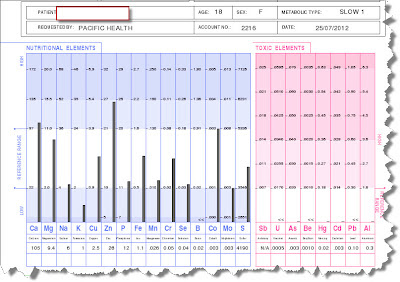
Exhausted female swimmer (NZ age group record holder) unable
 to swim for several weeks due to chronic chest infection.
Each one of the gifted young men and women, that are represented in these Hair Tissue Mineral Analysis reports, is on the cusp of internal representation.  One or two of them may have made the London Olympics if it was not for one thing:  They are chronically tired to the point of being ill!

(Please note that the swimmers represented in these reports have consented to me using their cases for this article).


Elite swimmer who is dead tired, always yawning and unable to
keep awake during the day.
I won't go into great detail about each individual report, or give any detail beyond age and gender, to protect the privacy of the swimmers.

Interpreting a Hair Tissue Mineral Analysis is complex and takes years of study and working with this test to fully understand the "ins and outs" of interpretation; But there are a couple of basic rules to bear in mind when eye-balling the main Nutritional Nutrients Chart.

Firstly, all of the nutrient bars for a healthy person, regardless of age, should be within the white "reference range".  Secondly, one does not want a chart which has a mix of "skyscrapers and valleys.  It is better to have all the bars high or low.

Exhausted age group record holder swimmer with chronic airways
infections and about to undergo nasal and sinus surgery.
Elite swimmer suffering "post-viral" fatigue
The complex patterns represented by the varying concentrations of minerals from the hair samples can be correlated with physiological functions within the body.  For example, elevated copper and calcium is strongly associated with low thyroid function. High calcium relative to potassium is strongly associated with chronic fatigue.  Varying levels of sodium and potassium are associated with varying degrees of adrenal fatigue.  Low molybdenum is associated with asthma and other lung disorders.  Low manganese is associated with cholesterol problems as well as joint and ligament disorders such as Osgood-Schlatters.  The list is long, as are the number of inter-relationships.  Toxic elements, such as mercury are like the Jokers in the pack - Their actions can be unpredictable and they always cause metabolic chaos.

What is seen in the charts of our tired elite swimmers is the bars are all over the place.  Few of the bars are in the reference range and each swimmer has a mix of skyscrapers and valleys. These are not healthy profiles.  There is a lot going on in these swimmers.


Here are some - but not all - of the patterns that are present in these reports:


  • Elevated calcium, relative to potassium and elevated copper, are the classic patterns for extreme fatigue.
  • High calcium is associated with thyroid disorders and sleep disturbances.
  • An imbalance between calcium and magnesium is associated with neurotransmitter disturbances, muscle cramps and heart irregularities.
  • Low phosphorus, especially in the presence of high calcium, is associated with poor mitochondrial function and a tendency to osteoporosis.
  • Low or elevated sodium and potassium are indicative of various stages of adrenal exhaustion.
  • Elevated zinc in the presence of low molybdenum is associated with viral, yeast and fungal infections.
  • Elevated iron relative to copper is indicative of a chronic infection and a resultant condition known as "infectious anaemia".
  • Elevated chromium relative to manganese is associated with cracking joints and ligaments, diseases such as Osgood-Schlatters and Perthes, as well as metabolic disorders affecting fat, protein and glucose metabolism.
  • Toxic elements such as arsenic, cadmium, mercury and aluminium interfere with just about every level of cell metabolism and are highly inflammatory - even when present in the tiniest amounts - Just a few parts per million is sufficient to cause metabolic chaos.

A swimmer who is trying out for Olympic representation does not want even one of these tendencies, let alone half a dozen or more!

These reports may come across as deeply depressing and the immediate reaction of the reader may be to say; "Give up!"  But I interpret each one of these profiles as "Performance Potential" or the glass being half full, rather than half empty.  If these young swimmers have done as well as they have with all this stuff going on then imagine just how much better they will perform once we have cleaned the slate of all this metabolic chaos?

Are swimming pool chemicals the cause of fatigue in elite swimmers?


Fluoride, chlorine and bromine are common pool chemicals.
These sit atop iodine and may interfere with iodine's
critical functions within the body.
Some of the elements found in pool chemicals are a factor in swimmer fatigue and ill-health.  The elements to focus on are the group of elements on the Periodic table known as the Halides.

These are fluorine, chlorine and bromine.  Fluorine is now added to most municipal water in New Zealand and this is what fills our swimming pools.  Chlorine is found in municipal water and extra is added to swimming pools as a disinfectant.  Bromine is used to sterilise water, particularly spa pools.

Included in the Halides family is iodine which, you will note, sits underneath the others.

Iodine for metabolism 

Iodine is required for healthy thyroid function and health in general.  Iodine has important anti-cancer properties.   Lack of iodine is implicated in breast and prostate cancer.  Iodine deficiency is associated with some connective tissue disorders.  Some studies have iodine deficiency in countries like New Zealand as high as 90% of the population.

As mentioned earlier, fluorine, chlorine and bromine sit atop iodine in the Periodic Table of Elements.  Each of these halides can be thought of as being "Iodine Bullies".  These bullies push iodine out of the thyroid and they crowd and consequently block the thyroid hormone receptors present on the surfaces of cells.  The consequence is thyroid dysfunction often felt as extreme fatigue, depression, aching muscles, poor muscle tone, poor immunity, cold hands, cold feet and weight gain, especially about the hips and waist.

Swimming pool water is not a very healthy medium to be soaking in daily!


When reviewing the health histories of elite swimmers, there are consistent patterns of fatigue and chronic illness.  There are high rates of glandular fever (Epstein Barr virus), yeast and fungal infections, sinus and chest infections.  When you look at their Hair Tissue Mineral Analyses, you see patterns that confirm this history of chronic ill-health and under-performance.

Elite swimmers may spend 20-30 hours per week bathed in a chemical solution of two or more of these harmful halides.  In addition, they breathe the air which also contains these substances and do so at a rate many times greater than a person at rest.  And most have been exposed to this environment since childhood.  It is therefore hardly a surprise to then encounter a succession of tired and ill swimmers.

As far as I know, every swimming pool in New Zealand is chemically treated and few are outdoors.

An outdoor pool would presumably be healthier in terms of the concentration of the harmful halides in the air.  A salt water pool, such as found at Bondi Beach, Australia, presumably has no chemical treatment.  One would assume that people who swim in outdoors saltwater pools will have a better standard of health, including showing little of no signs of ill-health associated with exposure to the harmful halides.

Interventions to improve the health of our four swimmers


Each of our swimmers has differing needs.  One, for example, is terribly infected and about to undergo quite major surgery on his sinuses.  All of them need nutritional therapy to offset the toxic effects of chlorine, fluorine and bromine.  All need to increase their intake of protein and a range of fats.  All of them need much more zinc and co-factors due to zinc metabolism problems.  All of them must cut back on calcium intake and increase their magnesium intake.

All four swimmers need more rest to ensure better recovery between training.  Their biggest gains in swimming performance will come from less time spent in the pool, more time resting and more effort balancing their nutrient intakes.

When it comes to training for swimmers:

Less is more!


I think too much time is being spent grinding out the miles in the pool day in - day out.  When tired, even the quality sprint sessions are not really "quality".  A fresh swimmer will train with better quality and be more consistent over the season due to few, if any, breaks due to illness and injury.  They will enjoy swimming more than ever and be less likely to give up.
I will be publishing updates on the progress of these four talented swimmers.  Our goal is to get all of them to the next Olympics.  This is a realistic expectation.  We have less than two years to get them right.  We will do it!
_______________________________________
About this website
The advice in these articles is given freely without promise or obligation.  Its all about giving you and your family the tools and information to take control of your health and fitness.

Thursday, August 12, 2010

Beginning the road to recovery from chronic fatigue and exhaustion

Permission received to use personal details
Hi Gary

I came to see you a couple weeks ago suffering from long term fatigue and exhaustion among other things following the birth of my two kids. I am excited to say that thanks to you I am slowly getting my life back. The vitamins and minerals and new diet regime is fantastic and I've noticed a significant increase in my energy levels and and general wellbeing.

Thanks again. Nicki
__________________________________________
Gary:
It is usually the case that the causes of so many ailments are quite straightforward.  It is also usually the case that medicating a "modern" health problem does nothing to resolve the actual causes of which there may several.

Treat the causes and not just the symptoms

In Nicki's case, she has several nutrient deficiencies and imbalances that are working against her health

Sunday, May 09, 2010

I have multiple health problems and feeling dizzy for the last six months

Hi Gary,
I had a look around your website and it seems you have an extensive knowledge.  I have had a number of health problems since August last year.

I have been diagnosed with a slighly underactive thyroid for which I am taking thyroxin now.  I was also told that my cold hand and feet (also turning blue) was Raynauds disease.  I researched this, but disagree since for me its not attacks as such, but rather a constant blueness in color of my feet and also any wounds.  I came to the conclusion that it must be acrocyanosis instead.

My other problems inlude dizziness, tiredness and I developed swelling of the lips, eyes and itchy skin in the last few months and I suspect it must be some kind of food allergy.  I also suffer from acne and dandruff.  The latest health scare I got was re-occuring blood after I have sex, not very much, but enough to scare me.

Tuesday, December 01, 2009

My experiences doing the Inter Clinical Laboratory Hair Tissue Mineral Analysis (HTMA) - by Jonathan


I had a HTMA test carried out on me and have been following its recommendations for just on 2 months. This is my experience of it, although first I will need to explain at least my recent past.

Image left: Jonathan during the Wild Coaster which was about two weeks into the start of the HTMA, "struggling like buggary up a hill".

I am 30 and have been increasing my time on the bike over the last few years to a point where this time last year I had what was probably my best race to date (Source 2 Sea) where I felt I did well in. I had trained hard and found the 160km race easy (I blew away the bunch that I was riding with easily and beat my cycling buddy who I train with all the time). I was down to about 98kg from just over the Clydesdale weight range (100kg). Things were good.


But then over summer I kidded myself at the endless BBQ’s parties and quickly put on weight till I rose to a hefty 108kg easily. I rode in the Around Brunner and had the second worst cycling experience of my life. I was cramping on every tiny “undulation” of the ride for the last 50km of the 130km race. It was horrible!


Image left: Chart from Jonathan's HTMA. Excess calcium relative to all other nutrients. Majority of nutrients are low. This is indicative of adrenal and thyroid insufficiency with tendency to gain weight, poor sleep, poor digestion and fatigue among other things. This sort of pattern is common in athletes.


I then realised my mistakes and trained as much as I could over winter but I was still not losing weight. I was doing a 3.5hr ride on the weekend plus at least one more hr ride during the week and maybe a swim. I stayed at the 107kg to 108kg weight range regardless of what I did. It made no sense to me either as I knew that I did not eat ridiculously unhealthily. I knew other people who would eat chips and chocolate etc and not put on weight but with me I was struggling to lose anything and easily putting it back on. Sometimes I would binge a little but this was usually after a large ride. I was feeling like crap going up the hill at the end of winter. I was getting smashed by my riding buddy as well.


I mentioned this to Gary as I had already been following a vitamin plan and it wasn’t noticeably working. He noticed that I was eating about the same as him per day (he weighs buggar all!!!). He suggested that I do the HTMA and I was more than happy to as I was desperate to find out what was wrong.


The results that came back were shit! They showed that I had been leading a modern lifestyle with far too many dairy foods in my diet (which I never suspected as I don’t drink straight milk and the media/advertising go on about all the Calcium we are “supposed” to need). I was getting it from too much cheese, yoghurt and milk from take away coffees. I also had really high (as in way off the chart) ratios between Calcium to potassium and magnesium which balance each other as nutrients along with a slow metabolism.


The HTMA suggested a change in eating habits, change in foods and a crap load of vitamins to correct the imbalance over the next 3 months. Gary said that you can just do it by nutrition alone without the vitamins but it will take much longer. I thought “if I am going to take some persons advise, I may as well do it properly and to the letter so that if it doesn’t work then I know I did my best". I know for sure that it doesn’t work (you will always have that doubt in the back of your mind if you don’t do something in its entirety as to if it works or not).


I knew it would be hard as I used to eat 3 large meals a day. If I didn’t feel full after a meal then I would be hungry till I did fill up. The HTMA suggested that I change to eating 5 or 6 small meals a day and change to a low calcium diet with at least 40% lean protein and the rest natural unprocessed foods etc (stuff Gary preaches often but I had never implemented… sigh).

My stats were 107.3 kg, 30.7% body fat, 2.9% Bone density 53.8% Water ratio and 43.4% Muscle mass.


This meant that for the first 7 days it was sheer will and determination that kept me going as I was hungry all day every day. However I dropped like 3kg and 2% body fat in 2 days!!!!!

The results were staggering in the beginning. The flab was just dripping off me. I found that you really had to be prepared in advance for your day by ensuring that you would have adequate food for the whole day. If I didn’t prepare and make my own food then there are virtually no quick options to buy suitable food elsewhere. It took a lot of will power because when you make a major decision such as this it seems that all the wrong food is shoved in your face on a regular basis. Even your mates seem to conspire to force you from your diet by trying to get you drink with them or force some ridiculously bad food on you.


Anyway after a month I was down to 99.6kg, 25.6% Body Fat, 2.9% Bone Density, 57.6% Water and 43.2 Muscle Mass.


This is when it actually got harder as the fat didn’t fall off as readily. I actually had to be more disciplined to lose the weight and by this stage my mind was playing tricks by trying to tell me that it was alright to eat that thing that isn’t on my diet as I had lost so much weight anyway.


By now 2 months into the diet I have made it to: 95.5kg, 23.1% Body Fat, 3.0% Bone Density, 59.4% Water, 44.5% Muscle Mass. So things have become harder which is frustrating.


I have found now though that I am riding faster and further than ever before. I am easily riding with much larger cogs going up a hill and easily recording faster times. I have not quite caught up to my riding buddy as he has been putting in a lot of hours and he has shot off. But I am still riding faster than I have ever before. To let you know how far I have come, just before I started this diet I was about 1.5 minutes behind my riding buddy up a hill that takes about 10 minutes to climb. That is a huge margin. However a couple of weeks ago I raced him up the same hill and beat him!!


The next month I want to get as close as I can to the 20% body fat mark or under if I can. Then relax the strictness in my diet a little and aim to rip up some cycle races during summer. I have to say that it feels great to shed that weight and I do not feel nearly as self conscious already. Can’t wait till the 3 month mark and I will feel any better. If you have been thinking or trying various diet fads then instead of that try the HTMA and get a scientific report of where your health is at so that you quickly correct any problems that you might have.

_______________________________

Gary comments:

Jonathan's metabolism had been steadily shutting down, mostly as a consequenceof relentless stress and poor eating habits. Welcome to the modern workplace! And then we are urged to go to the gym, run a half marathon etc in our free time. Bit like a double beat-up if you ask me!


The mechanism of this metabolic shut down centers about the adrenals. As they shut down, so does the thyroid gland. The consequence is feeling tired and depressed and the fat piles on while muscle is lost and they hurt. Once in this metabolic hole, the spiral is downwards as the person becomes increasingly depressed and desperately resorts to all kinds of crash diets which only makes matters wose.


Jonathan is using Salter 9106 Body Composition Scales to track his changes in wieght and composition. Weight changes alone tell only part of what is happening inside his body. He is a big boy, so once he is down to about 18% that will be enough fat loss. The emphasis should then go onto gaining more lean muscle by percent. Less than 12% fatness for a male is getting too thin.


The combination of the ICL Hair Tissue Mineral Analysis (Profile 2), the Brett Elliot Herbal Detoxification programme and a set of body composition scales are powerful tools for bringing about lasting weight losses and improvements in health and fitness. It frustrates me that millions are spent on unhealthy, invasive and risky weight loss measures, such as stomach stapling, yet there is no funding for simple and effective measures such as the programme being followed by Jonathan.


Your email address:


Powered by FeedBlitz


Do you have a question?
Email Gary: gary at myotec.co.nz (Replace the "at" with @ and remove spaces). Please include any relevant background information to your question.

Monday, September 21, 2009

Is there a link between depression, fatigue and nutrition?


Depression and low copper:
The mineral copper is involved in the production of neurotransmitters in the brain. A deficiency of copper can lead to depression.

Fatigue:
High calcium to potassium is associated with an underactive thyroid. Fatigue is often a common complaint associated with low thyroid function.

What can be seen in the chart to the left is this person is very low in many base minerals other than calcium, zinc cromium and sulphur. In nutrition, the ratios between nutrients are almost as important as the concentration of each.

The example here is typical of what comes across my desk, showing what happens when commercial food interests and single issue health lobbyists dictate public nutrition advice. High calcium, low fat, low salt, "heart healthy" diets are not healthy for every one. Some of us need more fat, more salt and more protein: Whereas others need less of these - some or all.

The person, in this case, has chronic health issues, including tendonitis and fatigue and is at risk of becoming depressed. It is all to do with diet.

The solution lies not in toughening up this person by joining a gym and/or counselling. Exhausting exercise may actually make things worse and counselling may only serve to buy some time. The solution, in this case, lies in adopting a low calcium, high protein diet that is low in fats, oils and carbohydrates and one that is high in vitamins and minerals. This includes taking a number of nutrition supplements for several months to expedite the process of replenishment and balancing. While the counselling can commence, the gym is best left till later on.

Contact me if you would like to learn more about this form of nutrient testing.

Your email address:


Powered by FeedBlitz


Do you have a question?
Email Gary: gary at myotec.co.nz (Replace the "at" with @ and remove spaces). Please include any relevant background information to your question.