_______________________________________
Gary Moller's old blog about health, fitness, nutrition, medicine, lifestyle and related topics.
Showing posts with label obesity. Show all posts
Friday, July 20, 2012
The National Sugar Rush
Thursday, November 04, 2010
Ask the weight loss expert teleseminar invitation
If it's weight loss you are seeking, then I urge you to invest 60 minutes of your time to find out how to start moving towards the body, health, energy and lifestyle you desire. It's a great time of the year to get a boost, so read on to see what we have in store for you.
Next week, I'll be joining forces with Craig Elliot, Mindset Coach and creator of the GET THE FAT OUT OF YOUR HEAD course to bring you a free tele-seminar, which I hope you can tune in for! This is something you can listen in on from the comfort of your own home,just by picking up your home phone and dialling in.
You need to register for the call first though - to do that go to Ask The Weight Loss Expert
Here are just some of the things you will learn:
=> How a low fat - high carb diet makes you fat.
=> How calcium makes you fat and wrinkles your skin
=> How a low salt diet makes you fat and tired
=> How ICL hair tissue mineral analysis can help you lose weight
=> How to use mineral therapy to bring about healthy weight loss
=> How to work all the above to be in your favour to make you lean and full of beans.
Craig's intention is to extract as much useful information for you as he can in the 60 minutes we have and to get to the most pressing questions you have - which you can either ask as part of registering for the call or on the call live which we encourage you to do. Craig will also share a few mindset tips to support you applying what you learn and to cultivate a slim, fit and healthy mindset.
You'll also be able to get access to more of his material if you are on the call - his approach is all about having the right mindset to make all that you need to do on a physical level do-able, easier and self sustaining.
Just a heads-up... We only have 100 phone lines available on this conference facility (actually 98 because Craig and I will take two of those lines)... If you want to get in on this call, then don't waste any time - go grab your seat for this special teleseminar...
Note; If you are calling in from New Zealand (or outside of Australia)then even though the seminar is free, there will be your usual toll charges for the call which will just come in via your phone bill. Craig worked it out to be under $20.00 which may vary a little depending on who you are with.
I hope you join me on the call!
Gary
_______________________________________
Wednesday, July 11, 2007
Obesity and Over Weight News
This page has a selection of newsfeeder search engines that I have set up to give you a summary of news about overweight and obesity as it happens.
Obesity is big business and it is important to be be informed of what is happening - what are the latest trends and therapies and what appears to be working. The big push is to medicate and provide surgical interventions. While there is increasing effort to have us exercise and eat better, there are not simple solutions to complex issues.
Use these newsfeeders to become more informed about these issues realting to obesity and overweight.
Bookmark this page so that it is added to your Favourites and drop by every day or so to see what's new in the world of news about overweight and obesity.
Saturday, June 30, 2007
Keep smokers and fatties out of the country - Doctors
5:00AM Saturday June 30, 2007, By Catherine Masters
Potential immigrants should be screened for obesity and smoking habits because they place such a heavy burden on health services, respiratory specialists have suggested.
Doctors Jeff Garrett and Andy Veale from Middlemore Hospital in South Auckland say obesity is a huge and increasing problem in Counties Manukau but chronic health disorders are not funded adequately. Obesity leads to a range of problems, from diabetes and cancers to respiratory disease and sleep disorders, and severely stretches an already cash-strapped budget, they say.
Their comments follow the death of Samoan mother Folole Muliaga, who was obese. She died after her power was cut off and she could not use her breathing machine.Mrs Muliaga arrived in New Zealand in 2000 and was first treated at Middlemore in 2002. Dr Garrett says South Auckland has more obese patients than most areas. "We've got something like 40 patients who are very similar to her in terms of their needs."
(For the full story, click on the title)
______________________________
Gary Moller comments
What is most revealing about the Muliaga case is the woeful inadequacy of modern "industrialised" medicine to deal with the chronic diseases of ageing and lifestyle; especially when there are cultural and language barriers to hurdle.In this case of morbid obesity, the "treatment" of this poor woman's obesity and consequent respiratory failure was to send her home with an oxygen machine. Sure, she might have had a few consultations with a nutritionist and maybe a few visits by a nurse at home; but these are hardly solutions.
As with the usual prescription of drugs to "manage" these lifestyle diseases, the adverse side effects are usually what finishes off the poor patient and not the disease. In this case, the adverse side effect of Mrs Muliaga's oxygen machine was skyrocketing power bills that the family could not keep up with. With the power company turning off the electricity to the home, that was the end of it for her.
Rather than whining about immigration and blaming the victims of their poor medical practices, these doctors who hail from the privileged quarters of society need to take a long hard look at how their own inadequacies as health professionals and consider how they actually contributed to this woman's death by prescribing a really dumb treatment. This trusting woman went to these docotors for help and she ended up dead. The sad truth is that the instruments that doctors have in their hi-tec tool box simply don't work for these kinds of health conditions.
Stereotyped attitudes about these lovely and trusting people also get in the way of providing effective health care.
As the article above says, Middlemore Hospital has about 40 other people with similar health problems. Let's get some proper health care for them.
Wednesday, February 21, 2007
Polynesians are fat - a sweeping generalisation
"Pacific Island nations have the most overweight people in the world, according to the most recent estimates by the World Health Organisation (WHO).
Eight out of the ten of the "fattest" countries are in the Pacific, the research found.
The top four - Nauru, Micronesia, the Cook Islands and Tonga - all have more than 90 per cent of their population defined as obese. "
______________________________________
Gary Moller comments:
There is unquestionably a serious world-wide obesity problem that is only going to get much worse before it gets better and that will not happen for several generations, if the latest crop of kiddies coming online right now are anything to go by. Polynesians are at the top end of the problem - there is no argument about that. But let's kill some stereotypes:
We have discussed BMI in a previous posting about how heavy boned and muscled people are penalised by the one-size fits-all limitations of BMI measures. Polynesians, being among the most naturally well muscled and big boned races on the planet are immediately at a disadvantage with regards to BMI. That does not mean to say Many, if not the majority, have a serious problem with obesity.
The solutions are simple but extremely difficult to implement because one comes up against unhelpful stereotypes and health resources are almost exclusively locked up in the ambulance services (Drugs, surgery, hospitalisation). But, for the moment, let's dispel these broad-brush misconceptions that all Polynesians are fat. There are many, many exceptions that include my immediate and extended family.
Polynesians that exercise regularly and who eat well make exceptional physical specimens that make scrawny people like me very poor examples of humanity. The holiday photos above show Alofa with the kind of food that produce a strong and healthy human. You will see, despite her high BMI, she is thin, but very strong, muscled and in glowing health. She, and the rest of her family, is not the obese and sickly stereotype of the Polynesian. The photo of Alama, our son who will never get skin cancer (btw) is significant because it shows a lean, muscular 7 year old with a narrow waist and a broad barrel chest. Incidentally, outside of Africa, this physique is most unusual nowadays. The swiiming togs he is wearing are sized for a three year old! My, how children have changed!
Good health is not about race - It is all about lifestyle - plenty of sun, exciting and stimulating exercise and lot's of good food. It is about choosing to walk to school and riding a bike to work, rather than to drive. It is about taking responsibility for one's personal health which means becoming informed about traditional and natural therapies and taking control of one's lifestyle - like placing family before work.
Monday, February 12, 2007
Can you be fat and healthy at the same time?
Hi Gary,
I’ve been looking for a web site regarding health/nutrition and stumbled over yours... plenty of info but wanted to ask a specific question and you certainly look like you know your stuff. So here goes...
With all these fat loss shows on television I thought I would find out my BMI was and correct weight for my height and age etc. I am 93kg, 173cm & 29 years of age. My BMI is 31, and to my surprise that tips me into the obese category. You can imagine my surprise... I am of European Maori descent and have always had extra pounds on me but never really anything extreme. I find it hard to get under the 90kg mark and very rarely have I been over the 95kg mark (since my mid 20's). I have exercised regularly for the past few years and over the last 12 months I have done two fitness boot camps over several months and that aside I am road running up to four times per week for 30 - 45min and a pump class on the weekend. I eat fresh food and minimal fats, although a like a few beers on Friday night after work and probably a bottle of wine a week over some Thai food.
Question being... Can someone be obese and healthy/fit at the same time? I feel im fitter then I have ever been but am labelled fat. What are your thoughts?
Thanks a bunch!
________________________________
Gary Moller comments:
One of the problems of one size fits all prescriptive health advice is it fails to cater for those who fall to the upper or lower ends of the population distribution curve. This is the failing of BMI measures. If you are a heavily boned and heavily muscled person, probably due to your Maori genes, then you are immediately in trouble with BMI which does not differentiate between muscularity and fat.
My best mate at university was a national class gymnast and springboard diver. He is part Maori and weighed in a collossal 14-15 stone (Very heavy for a gymnast). Going by BMI, he was grossly obese. But he was pure muscle and could lie on the bottom of the pool with a lung full of air and he could carry a fridge on his back no trouble.
The problem with this kind of body type is the tendency to go quickly to fat if the exercise is neglected and the eating not moderated. In your case, you are doing plenty of exercise - more than enough to remain fit and healthy and your diet seems fine.
Is fat unhealthy? Well the answer is "No!" In the case of the solidly built individual it is quite natural to have a healthy layer of fat. If you want to see a really unhealthy person, take a look at the zero fat body builder. A naturally heavily boned and muscled person should have some visible fat when healthy. To try to force fat levels below what your body is naturally telling you what it should be is distinctly unhealthy. In this case, forcing the body under 90kg or so would appear to be unnatural and therefore unhealthy. 95kg is fine, but this could be increased to 100kg if a weights programme was included in the weekly fitness regime.
As a related aside: Isn't it interesting that a person with high cholesterol often feels very healthy when first diagnosed. What is most interesting is how unhealthy the person then feels once going on a low fat diet and taking statin drugs. Fats, including cholesterol, are essential for good health; it is just a case of how much, in what form and what else comes with them.
One of the things a big guy has to take extra care of is his knees, hips and his heart even if all are currently in perfect working order. In addition to a healthy wholefoods diet, I recommend taking a mineral supplement that has magnesium in it (Due in part to loss through heavy sweating), a fish oil supplement and glucosamine and chondroitin. These are available from www.myotec.co.nz and we do deliver to Australia.
Monday, January 22, 2007
Gastric Bypass Horrors
Hi Gary,Well after 16 weeks my XXXX still has problems from his gastric bypass! The stomach still hasn't healed and his body is rejecting the naso-esophageal feeding tube. He's vomiting most nights and looks like shit!
But he has lost 80kg (or more) from the virtual starvation regime he has been on, so guess that's what they're going to do? He's been told that in the long run it was a success (well.. he has lost the weight...) so now they're going to reverse the procedure. That means another complicated operation and so naturally he's very depressed and more than a little afraid.
He still has a now somewhat deflated spare tire hanging around his waist so will probably need further "body sculpture" surgery to fix that.
He would have achieved the same result if he had not had the surgery and simply drunk the milkshakes he's been squirting up his nose and left it at that.
We are actually concerned about his chances of suviving another operation in his current condition.
Isn't medical science great!
Cheers,
Anonymous
____________________________
Gary Moller comments:
Well, it seems that the pre-holiday hype by the weight-loss surgeons worked and they had at least one taker looking for a "new me" for the New Year.
In my last occupation I got to see a regular procession of failures of routine surgery. For these people that "one in ten thousand" failure rate was 100%. Here in NZ the victim ends up carrying the can. It is very difficult and very costly to sue and the assistance from Accident Compensation is measley to the point of being a miserable insult.
In this case, it would appear there is leakage occuring at one of the points where the stomach and intestine have been severed and joined. The tube is feeding a liquid meal (A poor version of my Super Smoothie) into the gut past the point of leakage. The operation has been a failure and the plan to surgically reverse the procedure is fraught with risk. This poor man is already in a malnourished and weakened state and his friends have every right to fear for his survival.
This botched operation has probably cost well over $30k and rising by the day. The reversal will be another $20k. If only there was public funding for a team approach for closely supervised lifestyle, diet and exercise weight loss programmes, similar to what we see on TV reality programmes.
We hear littel about these failures - about 3,000 dead per year in NZ.
In this case, the poor recipient will eventually be chalked up as a success, although with complications. After all - he lost weight didn't he? Let's hope the success is not because he makes a good looking corpse in a regular-size coffin!
Saturday, December 23, 2006
Stomach surgery 'needed for teens'
"Surgeons are calling for children to be offered publicly funded stomach-stapling operations in a bid to treat soaring rates of extreme obesity.New Zealand hospitals have been reluctant to consider weight-loss operations in young adolescents because of the risks of major surgery, and the potential for long-term complications such as nutrient deficiency.
However, growing numbers of teenagers are so overweight they are suffering diseases previously seen almost exclusively in adults.
These include type-2 diabetes, sleep apnoea, high blood pressure and gall bladder disease.
Some are at risk of heart attacks and strokes in their 20s.
Paediatric surgeons are saying it is time to make stomach-stapling surgery more readily available with the complicated health needs of morbidly obese adolescents now impacting on the care of other children.... The surgery can cost between $12,000 and $20,000 and about 400 a year were done, most on adults and only a handful publicly funded. "
To read the full article, click on the title above.
_______________________________________
_______________________________________
Gary Moller comments:This kind of surgery produces a very uncomfortable feeling in my gut. The reason why is that stomach stapling surgery is an over-priced solution that, at best, only indirectly targets the cause which is the lifestyle of the positionally challenged. It is symptomatic of irresponsible, neglectful parenting, poor food choices and a societal bureaucracy that engenders a fear of all things natural, including the outdoors, sunshine and water.
There is an alternative to stomach stapling: I used to run rehabilitation programmes for long term Accident Compensation clients: people who had been seriously injured, incompletely rehabilitated following surgery, consequently losing their jobs and becoming unemployable due to ongoing health problems, loss of work skills, confidence and poor personal habits.
Rehabilitation focussed on gradually replacing old unhealthy habits with healthy ones. This was a challenging process that took 12 weeks to be successful. Successful it was, and almost without exception - and for a cost of from $3-$6,000. What was a constant frustration were the constant demands by the health and funding agencies to cut back on the cost of these programmes, the preference being to spend their money on high technology surgical solutions at quadruple the cost or more. These intervention programme were progressively reduced to about 5 weeks for several hundred dollars - effectively rendering them a complete waste of time.
The same model of gradual behavioural change can and should be applied in cases of extreme childhood and teen obesity and they need to involve the entire family. Costing probably no more than $6,000 and lasting 12 weeks, the outcome will be fit, strong and healthy families that play together.
This is a far better prospect than surgically turning out thinner teens who then face uncertain lives that are still a constant daily preoccupation with food and at serious risk of malnutrition-related ailments and shortened lives.
Note: The Google Adsense ads to the right of this article can interesting to peruse. You will see that there is quite an industry, involving drugs and surgery, surrounding obesity. It is no conicidence that the call by surgeons for public funding of this kind of surgery for teens comes at the time of year of greatest over-indulgence and just in time to capitalise on all the New Year's resolutions for weight loss. Am I just being too cynical?)
Sunday, July 16, 2006
Obesity is not the problem - it is Soft Body Syndrome
We hear so much nowadays about the evil that is obesity. While I do not disagree that obesity is a major health problem that is associated with many, many ailments, I feel that there is a misguided and even unfair focus on obesity per se. Obesity is the outward manifestation - the symptoms - of the real problem.Are we picking on the obese because they are an obvious and easy target? Obvious? - Yes! Easy target? - Yes! Right target? - Wrong!
I was repeatedly reminded of this during our recent holiday in the far North of sunny Queensland, Australia during their school holidays. Australia has some serious problems looming with its young people - America, move over - here come the Aussies! I have never seen so many soft young bodies in my life, as I did on the Queensland beaches. Sure, there were many obese kids and young adults; but these were the minority. The majority were bodies that, while they would have fallen mostly within healthy BMI ranges, exhibited total lack of body tone - soft bodies - bodies that have little musclulature, weak cardiovascular systems, high levels of body fat and weak skeletons.
I have said many times over the years that thin people also get cancer, have heart attacks and get sore backs.
There are plenty of people who are quite "fat" yet are very strong and have a high cardiovascular capacity. These people are those born with a genetic body type that has high endomorphic and mesomorphic characteristics - many of our Polynesian people, for example. They stay healthy if they eat well and exercise hard. These endo-mesos will only ever achieve pencil thinness at the risk of anorexic death. Regardless of body type which can never be altered, the real health risk is if one is raised soft, thus producing what I call Soft Body Syndrome (SBS).
SBS is the leading health issue facing most, if not all developed countries. Targetting food manufacturers - MacDonalds, Coca Cola, no matter how commendable that might be, or trying to get kids to eat less - is not the real solution to SBS. All this will produce is thnner SBS's which one could argue is actually a less healthy condition than an "over weight" case.
The answer to the problem is daily physical activity and the best thing we could do to get the ball rolling in the right direction is introduce daily physical activity for children in schools, beginning with pre-school centres. Compulsory because the majority of young adults nowadays, including teachers, know little else other than positionally static behavours.
We cure SBS by endowing our children - boys and girls - with Hard Bodies.
Saturday, July 01, 2006
Losing weight is as easy as 3+3
In my recent article about who were the biggest losers at the Melbourne Commonwealth Games, I began by expressing my horror at the way obese participants in the reality TV programme "The Biggest Loser", were made to go about exercising. It was horrific. The risk of injury was excessive as was the risk of a heart attack or stroke. Early arthritis - roll on! One thing for sure, if these people were not committed on national television and followed and cajoled every moment along the way, they would certainly have given up and never succeeded.
Exercise and diet programmes that are painfully ascetic are ultimately doomed to fail. This failure usually results in a rebound further behind where they first began - less fit and much larger. A far more sensible and less injurious approach is to make enjoyable and less drastic changes to one's life - changes that are more or less immediately rewarding and which can be continued for life. This is the approach that was so successfully demonstrated at the Melbourne Commonwealth Games.
As easy as 3 + 3
Three good meals a day and nothing in between other than a drink of water and maybe a piece of fruit. My gosh! Doesn't food taste great when the tummy is rumbling! I am reminded of my childhood when we went for hours out in the bush and farmland without a fridge or convenience store to be seen. We ravenously ate everything Mum served up.
A big swig of water now and then can fill the tummy a while between meals and the water assists fat metabolism. The herbal Brindleberry formulation can assist fat loss and dulling the hunger pangs for those who need a little assistance adjusting to a 3 meal day. Another trick is to have a tablespoon of Whey Protein in a glass of warm milk between meals. The whey helps to stabilise blood insulin levels.
Three workouts a day is all it takes to stoke the metabolic fires white hot to burn excess fat and tone the muscles. For most people this might begin with an early morning walk around the block, or walking to work. For me, its running alongside my son as he rides his bicycle to school. Then its another brisk walk before lunch. This could be deliberately planning to do a delivery on foot. The third could be walking home, a workout in the gym, swimming, a Pilates class or playing sport with the kids. For me, its a run to school to pick up my son. Its part of my daily "father-son bonding programme". A good tool for convenient exercise anywhere, including at home is the Myotec pocket Gym. Your body loves both set routine and variety.
Now this might seem like a lot of exercise. Well, it isn't really because it is planned and opportunistic exercise that can be easily fitted into a busy lifestyle. Furthermore, these are opportunties to interact with loved ones, friends, workmates and neighbours in a relaxing and healthy way. It gets you well away from the fridge and it will encourage you to select healthier choices for meal times.
Make a habit of it
It takes from 8-12 weeks of doing something for it to become habit. Once it is an ingrained habit, it feels uncomfortable to stop. The habit becomes part of one's lifestyle. So, timing is important: choose a time of year when you are certain that you can keep your new eating and exercising patterns going for at least 8 weeks without disruption. But let's face it; there is no better time than right now!
Friday, June 16, 2006
2006 Commonwealth Games - who were the biggest losers?
This article was first published in Walking New Zealand magasine (Issue 101 - 2006).
Have you seen the reality TV programme, “The Biggest Loser”, in which grossly obese men and women compete for a prize by trying to lose the most weight? I cringed in horror at the sight of these masses of humanity lumbering their way through violent exercises and extreme diets: Who will be the first contestant to destroy a knee, back or even drop dead! The recent Commonwealth Games demonstrated a much better variation of the “Biggest Loser” game.
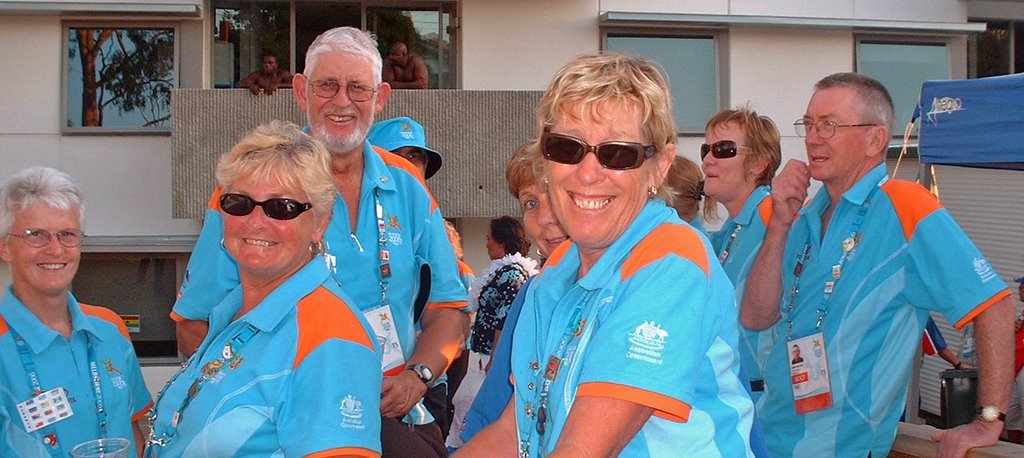
When I arrived at the Commonwealth Games Athlete’s Village, as manager of the Cook Islands cycling team (consisting of one cyclist), two things stood out from everything else: The army of smiling and helpful volunteers and the food!
From the moment we stepped off the plane at Melbourne airport, we were surrounded by Games Volunteers. All we had to do was switch the brains off and follow. Everything was done for us from that point onwards. These volunteers were ordinary people, mostly from Melbourne City, who were giving freely of their time for a month to cater for the thousands of athletes, officials, dignitaries and sports fans who descended upon the city for the Games. It was over-kill: For just 4,500 athletes, there were over 16,000 volunteers! We loved the attention.
When I entered the huge athletes’ dining hall for the first time, my immediate reaction was; “To Hell with the training and competition – let’s see how much we can eat over the next few weeks!” The menu included dishes from every continent and these varied every day. Open day and night - and free! - We could eat as much as we liked and as often and wheneve
r the desire took hold.
I was convinced that everyone was going to put on weight – and lots of it.
How wrong I was; the opposite was the case with substantial weight losses being the reported norm. How could this be?
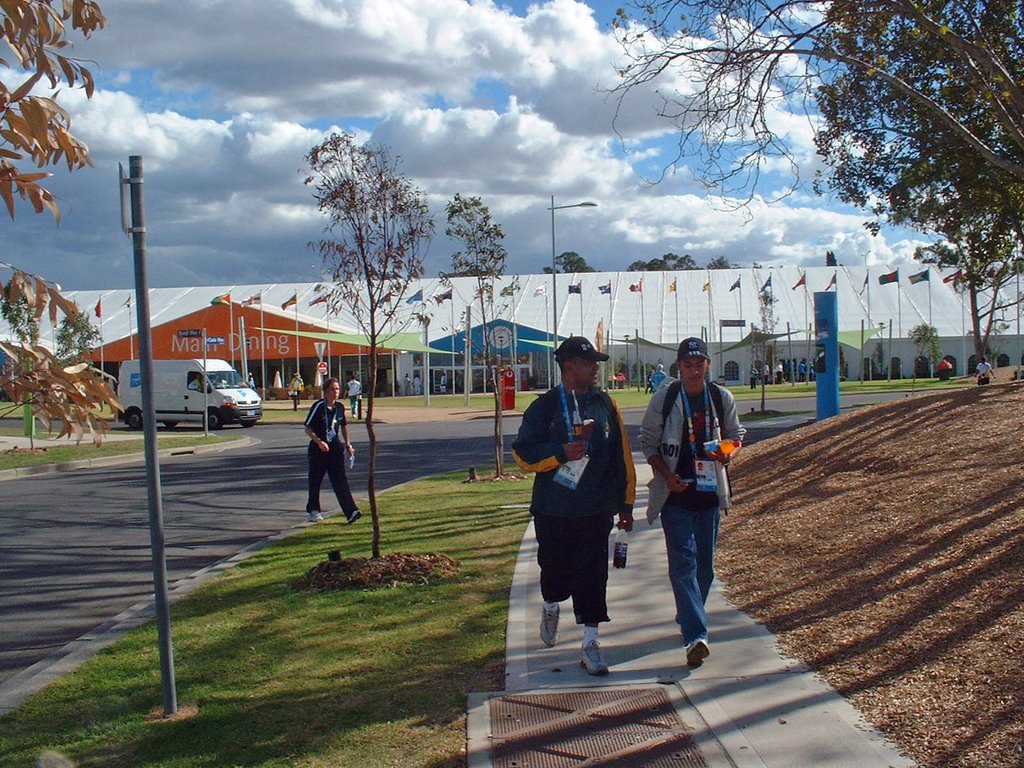
The reason was simple: We walked everywhere within the village. There were no cars inside the village which covered several blocks. Sure, there was an excellent internal bus service and a few bikes; but most of the villagers preferred to walk because it was the best way to meet others, especially the athletes from the African, Oceania and Caribbean countries who tended to congregate to sit, chat and play on the streets.
A typical day began with the walk to the dining hall a few blocks away, stopping to chat with athletes along the way. After a good feed, it was back to our unit, usually with a diversion to a cafĂ© for a decaf coffee, a bun and more chatting with the interesting folk of the Commonwealth. Then there was another walk to get out of the village to get to the training or the competition venue. Lunch, dinner and evening supper were pretty much the same routine of walking, meeting and greeting – and eating, of course! I made a resolution to sample at least one new ethnic dish each time I sat down for a feed.
So what was going on here? Why did we lose weight?
What happened was both simple and brilliant at the same time.
For a start, there was little snacking; but still a ton of calories to consume. It was 3-4 square meals per day with maybe some floury Australian pip or stone fruit in between (I craved for crisp, juicy NZ fruit). This meant we were taking in large dollops of delicious, nutritious, high calorie food that stimulated the metabolic processes throughout the day. This is in contrast to a low calorie diet that encourages the body to shut down its metabolic processes and to conserve body fat.
Then there was the exercise in the form of walking, again in generous dollops that were spread from dawn to dusk. With fuel to burn, the internal metabolic fires were vigorously stoked by the exercise to burn white hot throughout the day.
In contrast, calorie restriction shuts down the metabolism. This is a natural survival mechanism. While exercise counters this metabolic shutdown to a degree, any extra calories are immediately scavenged and stored as fat. Nutritional deficiencies are the norm with the modern calorie restricted diet and these eventually lead to all manner of ailments ranging from depression to osteoporosis.
All of the volunteers, I asked, reported either weight loss of more than a few kilos and/or thinner hips and waist. It was important to ask this of the volunteers because they were not highly tuned athletes. For the most part, they were typical, sedentary Australians with a predominance of them being older and many retired. With all of that free food, weight gain should have been the norm. But it was not the case because they had a generous supply of rich metabolic fuel and they stoked their metabolism with exercise and oxygen.

The Commonwealth Games Athletes’ Village was a working model for communities of the future. Or, is this a case of going “back to the future?” There will be little need for private cars. Design and layout will enable access to community facilities either by walking, bicycle or free public transport. Obesity and the diseases associated with it will be a rare occurrence. People will know and interact with their neighbours.
In the meantime, while we patiently wait for the politicians, bureaucrats and the designers to work out how to turn us all into losers, we can get on with the job for ourselves: Eat well, get outside and walk everywhere - and greet everyone you pass along the way while you are at it.
Have you seen the reality TV programme, “The Biggest Loser”, in which grossly obese men and women compete for a prize by trying to lose the most weight? I cringed in horror at the sight of these masses of humanity lumbering their way through violent exercises and extreme diets: Who will be the first contestant to destroy a knee, back or even drop dead! The recent Commonwealth Games demonstrated a much better variation of the “Biggest Loser” game.

When I arrived at the Commonwealth Games Athlete’s Village, as manager of the Cook Islands cycling team (consisting of one cyclist), two things stood out from everything else: The army of smiling and helpful volunteers and the food!
From the moment we stepped off the plane at Melbourne airport, we were surrounded by Games Volunteers. All we had to do was switch the brains off and follow. Everything was done for us from that point onwards. These volunteers were ordinary people, mostly from Melbourne City, who were giving freely of their time for a month to cater for the thousands of athletes, officials, dignitaries and sports fans who descended upon the city for the Games. It was over-kill: For just 4,500 athletes, there were over 16,000 volunteers! We loved the attention.
When I entered the huge athletes’ dining hall for the first time, my immediate reaction was; “To Hell with the training and competition – let’s see how much we can eat over the next few weeks!” The menu included dishes from every continent and these varied every day. Open day and night - and free! - We could eat as much as we liked and as often and wheneve
r the desire took hold.I was convinced that everyone was going to put on weight – and lots of it.
How wrong I was; the opposite was the case with substantial weight losses being the reported norm. How could this be?
The reason was simple: We walked everywhere within the village. There were no cars inside the village which covered several blocks. Sure, there was an excellent internal bus service and a few bikes; but most of the villagers preferred to walk because it was the best way to meet others, especially the athletes from the African, Oceania and Caribbean countries who tended to congregate to sit, chat and play on the streets.
A typical day began with the walk to the dining hall a few blocks away, stopping to chat with athletes along the way. After a good feed, it was back to our unit, usually with a diversion to a cafĂ© for a decaf coffee, a bun and more chatting with the interesting folk of the Commonwealth. Then there was another walk to get out of the village to get to the training or the competition venue. Lunch, dinner and evening supper were pretty much the same routine of walking, meeting and greeting – and eating, of course! I made a resolution to sample at least one new ethnic dish each time I sat down for a feed.So what was going on here? Why did we lose weight?
What happened was both simple and brilliant at the same time.
For a start, there was little snacking; but still a ton of calories to consume. It was 3-4 square meals per day with maybe some floury Australian pip or stone fruit in between (I craved for crisp, juicy NZ fruit). This meant we were taking in large dollops of delicious, nutritious, high calorie food that stimulated the metabolic processes throughout the day. This is in contrast to a low calorie diet that encourages the body to shut down its metabolic processes and to conserve body fat.
Then there was the exercise in the form of walking, again in generous dollops that were spread from dawn to dusk. With fuel to burn, the internal metabolic fires were vigorously stoked by the exercise to burn white hot throughout the day.
In contrast, calorie restriction shuts down the metabolism. This is a natural survival mechanism. While exercise counters this metabolic shutdown to a degree, any extra calories are immediately scavenged and stored as fat. Nutritional deficiencies are the norm with the modern calorie restricted diet and these eventually lead to all manner of ailments ranging from depression to osteoporosis.
All of the volunteers, I asked, reported either weight loss of more than a few kilos and/or thinner hips and waist. It was important to ask this of the volunteers because they were not highly tuned athletes. For the most part, they were typical, sedentary Australians with a predominance of them being older and many retired. With all of that free food, weight gain should have been the norm. But it was not the case because they had a generous supply of rich metabolic fuel and they stoked their metabolism with exercise and oxygen.

The Commonwealth Games Athletes’ Village was a working model for communities of the future. Or, is this a case of going “back to the future?” There will be little need for private cars. Design and layout will enable access to community facilities either by walking, bicycle or free public transport. Obesity and the diseases associated with it will be a rare occurrence. People will know and interact with their neighbours.
In the meantime, while we patiently wait for the politicians, bureaucrats and the designers to work out how to turn us all into losers, we can get on with the job for ourselves: Eat well, get outside and walk everywhere - and greet everyone you pass along the way while you are at it.
Friday, April 21, 2006
It is time to make daily physical activity compulsory in schools
We have to make daily physical activity compulsory in schools and childcare facilities and we have to do this right NOW!News reports today that heart disease rates, including deaths, are skyrocketing in younger people while rates are dropping in older people are further indications of what we face over coming years. We have the added problem of the tsunami of ageing Baby Boomers who are making increasing demands on health and welfare services. Our health and welfare services are caught in a deadly pincer maneuver coming from above and below.
Couple this with reports today, by medical specialists, that the health system is "rotten to the core", lurching from one crisis to another, and it is clearly time for positive action. I want an end to all the talk and dithering. Let's see some real action for a change.
While there are no single solutions to this enormous problem an inexpensive and effective measure that can and should be introduced immediately is daily compulsory physical activity in every school and childcare facility. What I can tell you from years of experience in prescribing exercise is that regular physical activity that is practiced for at least 8 weeks brings about significant and often dramatic improvements in physical and mental health.
If practiced consistently for longer than 8 weeks, it is almost a given that the participant will continue to exercise indefinitely because it has become a positive habit much like the habit of brushing one's teeth if not brushed that day, the person feel uncomfortable. Same happens with habitual exercise.
Other beneficial changes happen: The exercise participant, without any need for persuasion, will make subtle, yet important improvements to their diet, including eating more fruits and vegetables and eating less "junk food". These people are most unlikely to become smokers and, if a smoker, are more likely to succeed in giving up.
"Make the parents responsible for exercising their children and feeding them properly", you might argue. My response is to say, "Give up on that idea". What we have coming through nowadays is new parents who are the first generation that really were the junk food kids that were driven everywhere by Mum in the back of the SUV. They are now the ones who are having the children. These new parents know nothing else and, regardless of escalating fuel prices, they will persist in driving Jane and Johnny to school and everywhere else; and, for them, "party food" is the norm.
A further issue is that the new teachers now coming into the schools are the same as young parents - they have little understanding of exercise, how to incorporate it into daily life, how to make it fun and effective and they know little, in practice, about what consititutes a healthy diet. While some schools or classes have daily physical activity, these are by far in the the minority and these rely on the enthusiastic drive of a few individuals. It would be folly to try to extend these programmes by relying on the voluntary participation by statically challenged teachers who know nothing other than sloth and bags of potato chips.
The solution is compulsory daily physical activity in schools and childcare facilities that is taken by each class teacher for his or her pupils. While there will be resistance, this will abate as the programme progresses beyond 8 weeks and the practice becomes a habit for all and the benefits, like less absenteeism and better academic grades, begin to kick in.
Subscribe to:
Posts (Atom)